
Tokushima Prefecture sits on the eastern edge of Shikoku island, and it has a quiet reputation among travelers who care about how tourism intersects with the places it passes through. When you search for sustainable accommodation here, the results look different from most of Japan. You won’t find a long list of internationally certified eco-resorts. Instead, you’ll encounter a zero-waste hotel where there are no trash cans in the rooms, an off-grid house built from old tires and rainwater, and a farmstay run by a couple who moved from Tokyo to grow citrus fruit in the mountains.
This article covers six properties in Tokushima whose sustainability practices we were able to verify directly from official sources — their own websites or official affiliated pages. It’s not a ranking, and it’s not a recommendation in the prescriptive sense. The goal is to give you accurate, sourced information so you can decide whether any of these places match what you’re actually looking for from a trip. Not choosing any of them is also a valid outcome.
All information reflects what was confirmed in June 2026. Certifications and practices change, so we recommend checking each property’s official site before booking. All practices described are based on information explicitly stated or reasonably inferred from official sources. Where we’ve summarized or paraphrased official content, we’ve noted it as such.
How We Selected These Properties
We applied four criteria, all based on what could be independently confirmed in official sources. Properties that weren’t verifiable — regardless of how interesting they sounded — were excluded.
- Transparency of information The property explicitly describes its sustainability practices, policies, or metrics on its official website — not just uses the word “eco” or “sustainable” as a label
- Concrete environmental approach Specific practices are documented: energy systems, waste reduction, water use, building materials, or similar
- Built environment and resource continuity Preference for adaptive reuse or contextually integrated construction — traditional farmhouses, closed schools, historic townhouses — where applicable
- Relationship with local community, culture, and agriculture Documented connections to local farmers, craftspeople, cultural traditions, or regional economic ecosystems
The Properties
1. Kamikatsu Zero Waste Center — HOTEL WHY
Location | Kamikatsu Town, Katsuura District, Tokushima Prefecture — mountain village, car access recommended
About the property
In 2003, Kamikatsu became the first municipality in Japan to declare a Zero Waste goal, aiming to eliminate landfill waste entirely. HOTEL WHY is the town’s experiential accommodation — a place where staying overnight is inseparable from engaging with that declaration.
The name is deliberate. The design is intended to prompt questions about everyday consumption — why is there no trash can in the room, why does the handle on the wardrobe look like a river stone, why is the curtain made of mismatched fabric scraps?
Sustainability practices — confirmed by official sources
There are no trash cans in the guestrooms. Instead, guests receive a handled basket containing multiple sorting containers and are expected to separate their own waste during their stay. The building uses cedar sourced from Kamikatsu, and the interiors incorporate upcycled materials throughout — reused fixtures, furniture, and architectural elements — including curtains sewn from fabric offcuts and drawer handles made from river stones.
The property offers guided programs that introduce Kamikatsu’s circular resource systems (availability varies; confirm on the official site before booking).
Who this might suit
Travelers who want to understand zero-waste thinking through experience rather than reading about it. People with a specific interest in Kamikatsu as a case study in municipal environmental policy. Anyone who finds the gap between knowing something intellectually and actually living it for a day worth traveling for.
Things to be aware of
Kamikatsu is a mountain village with no practical public transportation access. The stay is structured around separation, learning, and reflection — not sightseeing or relaxation in the conventional sense. If you’re looking for a comfortable base for exploring Tokushima, this isn’t that.
For more details
2. AoAwo Naruto Resort


Location | Naruto City, Tokushima Prefecture — within the Seto Inland Sea National Park, approximately 3 minutes by car from Otsuka Museum of Art
About the property
AoAwo Naruto Resort is a full-service resort hotel overlooking the Naruto Strait, the narrow channel between Shikoku and Awaji Island known for its tidal whirlpools. It’s the most conventional “hotel” on this list — large-scale, amenity-rich, and located near one of Tokushima’s most visited attractions. It’s also the property that most explicitly documents its sustainability work: the hotel maintains a dedicated SDGs page on its official website and has publicly committed to the United Nations Sustainable Development Goals.
Sustainability practices — confirmed by official sources
Guest amenities include hairbrushes, toothbrushes, and razors made from rice husk biomass material, and body towels made from 100% natural cotton. For guests staying multiple nights, a card-based linen reuse program lets each guest indicate their own preference for towel and sheet changes.
The hotel reports energy-saving measures including LED conversion across the property. The hotel also documents staff participation in Naruto City coastal clean-up activities and contributions to the Tokushima White Stork Fund on its SDGs page.
Cultural programming includes Awa Odori dance experiences and Awa Hon Ai (natural indigo dyeing) workshops — two of the traditional crafts most closely associated with Tokushima.

Who this might suit
Travelers combining the hotel with a visit to the Otsuka Museum of Art, which houses full-scale ceramic reproductions of over 1,000 Western masterpieces. People who want documented sustainability practices alongside the amenities of a resort stay. Families or groups where not everyone wants an intentional eco-experience but some members do.
Things to be aware of
As a large resort, the experience differs significantly from the smaller, place-specific properties on this list. Some information on the SDGs page does not carry update dates, so current details are best confirmed directly with the hotel.
For more details
Ikkyu
 JTB
Expedia
Yahoo!Travel
Rakuten Travel
Rurubu Travel
Jalan
JTB
Expedia
Yahoo!Travel
Rakuten Travel
Rurubu Travel
Jalan
3. Tougenkyo Iya no Yamazato


Location | Higashi-Iya Ochiai District, Miyoshi City, Tokushima Prefecture — one of Japan’s three “hidden regions,” car access essential
About the property
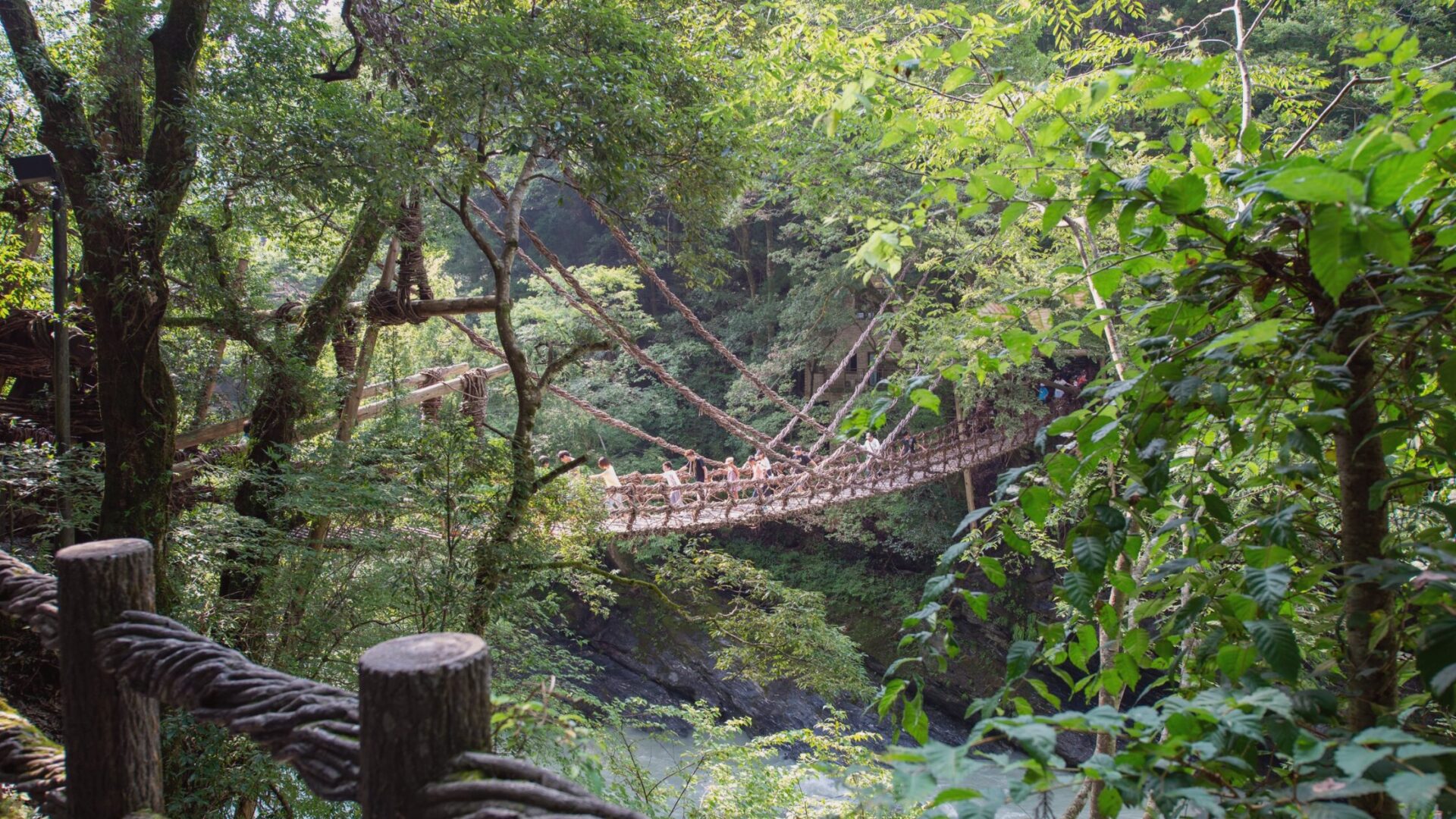
The Iya Valley in western Tokushima is one of the most remote and topographically dramatic landscapes in Japan — steep ravines, vine bridges, and hamlets that became refuge settlements centuries ago for defeated warriors fleeing the capital. Tougenkyo Iya no Yamazato sits within the Higashi-Iya Ochiai district, a settlement designated by the Japanese government as an Important Preservation District for Historic Buildings.
The property consists of a collection of thatched-roof farmhouses (kayabuki kominka) dating from the Edo and Meiji periods, each offered as a private, standalone rental. They were restored under the supervision of architect and writer Alex Kerr, whose work preserving traditional Japanese rural architecture spans several decades. The project reflects a philosophy of minimal intervention and preservation, often associated with Alex Kerr’s work — the idea that what remains, rather than what is added, is the point.
Sustainability practices — confirmed by official sources
Each farmhouse has its own name. The core practice here is continuation: restoring and maintaining structures that already exist rather than building new ones. The Higashi-Iya Ochiai district’s designation as a nationally protected preservation area means the cultural landscape itself is the context for the stay.
The official site includes information on food, experiences, and nearby resources, with documentation of locally sourced ingredients and surrounding community businesses.
There is no mention of SDG commitments or environmental certifications on the official site.


Who this might suit
Travelers with a genuine interest in traditional Japanese rural architecture and the thatched-roof farmhouse aesthetic. Anyone who wants to spend time in the Iya Valley specifically — this is one of the few ways to sleep inside it, not just visit. People for whom stillness and landscape are the point of the trip.
Things to be aware of
Car access is essential — this is mountain terrain. There are no environmental KPIs or certifications published. If measurable impact data matters to your decision-making, this property won’t provide it.
For more details
Ikkyu Expedia
Yahoo!Travel
Rakuten Travel
Expedia
Yahoo!Travel
Rakuten Travel
4. Earthship MIMA
Location | Mima City, Tokushima Prefecture — approximately 20 minutes by car from Mima IC
About the property
An Earthship is a type of off-grid building developed by American architect Michael Reynolds from the 1970s onward, using recycled materials — primarily old tires, glass bottles, and aluminum cans — as structural components. The design integrates solar energy, rainwater harvesting, and internal greywater systems. There are a few hundred Earthships worldwide, mostly in the American Southwest.
Earthship MIMA, built in November 2018 in collaboration with Earthship Biotecture (the New Mexico-based organization Reynolds founded), is one of a small number in Japan. Accommodation is for one group per night.
Sustainability practices — confirmed by official sources
The building is designed to operate primarily on solar-generated electricity, stored via rooftop panels. Drinking and washing water comes from collected rainwater, filtered on-site. Bathwater and sink water drain through the root systems of plants growing inside the structure. The walls incorporate old tires, glass bottles, and aluminum cans as building materials. The passive thermal design is intended to reduce the need for mechanical heating and cooling, using the thermal mass of the structure to moderate interior temperatures year-round.
All of the above is explained on the official site as foundational to the building’s design philosophy.
Who this might suit
People curious about what off-grid living actually feels like as a bodily experience, not just a concept. Travelers interested in alternative architecture, sustainable building systems, or low-impact design. Anyone who has read about Earthships and wants to spend a night in one rather than just look at photographs.
Things to be aware of
The comfort level differs from a standard hotel stay by design — that’s the point, but it’s worth knowing before you book. For reservations and current contact information, check official social media channels in addition to the website.
For more details
5. WEEK Kamiyama
Location | Kamiyama Town, Nishi District, Tokushima Prefecture — along the Akui River
About the property
Kamiyama Town has been referenced internationally as an example of rural revitalization through creative migration — a place that drew satellite offices, artists, and craftspeople into a mountain town that might otherwise have continued to depopulate. WEEK Kamiyama is a guesthouse that has grown alongside that story, occupying a renovated farmhouse dating back several decades (formerly the Minami residence) alongside a newer lodge built with local Kamiyama cypress and cedar. All rooms face the Akui River.
Sustainability practices — confirmed by official sources
The property sources its produce directly from local organic farms — specifically Ohisan Farm Chino and Satoyama no Kai, both named on the official site. Beyond sourcing, the guesthouse itself borrows farmland from Chino Farm next door and grows its own salad greens, herbs, and tomatoes. The official site states: “Getting firsthand experience of the full cycle from soil preparation to harvest is essential to our role of communicating the region through food.”
The “Kamiyama Plate” — a set meal featuring local ingredients — is available with advance reservation. The building uses Kamiyama-sourced timber and has maintained and repaired a structure that has stood for over 60 years rather than rebuilding.
There is no mention of SDG commitments or environmental certifications on the official site.
Who this might suit
Travelers interested in the intersection of food, agriculture, and place. People considering a workcation or longer stay in rural Japan — Kamiyama Town has an established infrastructure for that. Anyone who wants to understand what “farm-to-table” looks like when the farm is a ten-minute walk from the kitchen.
Things to be aware of
No environmental certifications are published. Please confirm current availability, pricing, and meal arrangements directly with the property before your visit.
For more details
6. Mikan Farmer’s Inn — Aotokuru
Location | Katsuura Town, Katsuura District, Tokushima Prefecture — mountain valley along the Katsuura River
About the property
A couple who relocated from Tokyo to Katsuura Town runs this one-group-per-night farmstay in a farmhouse that is approximately 100 years old. They grow mandarin oranges and other citrus fruit on the hillside above the house. The ground floor of the farmhouse opens as a guesthouse during the off-farming season (April through October). The entryway also houses a small used bookstore, Kosho Bun, open to both guests and locals.
Sustainability practices — confirmed by official sources
The official site states that the citrus crop is grown using organic fertilizer, with a deliberate approach of not increasing the number or amount of pesticides used, guided instead by observation of the trees and fruit. This is documented as a farming philosophy, not a certified organic claim.
The farmstay experience centers on shared cooking: guests join the hosts in preparing meals using vegetables from the property’s own seasonal garden. The official site describes this as a core part of the stay — “cooking dinner and breakfast together using vegetables from the fields.” The style of the accommodation is best described as living alongside the farmers, not staying at a hotel that happens to be near a farm.
There are no SDG commitments or environmental certifications documented on the official site.
Who this might suit
Travelers looking for an agricultural homestay experience, not just a rural accommodation. People visiting Tokushima between April and October who want to spend time in a genuine farming household. Anyone for whom eating what the land immediately around them produces — and cooking it with the people who grew it — is worth traveling toward.
Things to be aware of
Guest stays are offered during specific months of the year (typically April through October; confirm the current schedule on the official site before booking). Please confirm current booking availability and access through the official site or booking channels before your trip.
For more details
A Note on What’s Not Included
Every property in this article was verified directly from an official source. Several other Tokushima properties appeared in our initial research but were excluded because their official websites were inaccessible at the time of verification, or because the sustainability information available came only from third-party sources rather than the properties themselves.
Certifications and programs evolve — what’s accurate in June 2026 may have changed. For properties with time-sensitive credentials (energy ratings, third-party certifications), we recommend confirming current status before your visit.
Final Thoughts
Six properties, six entirely different interpretations of what sustainable hospitality looks like in practice. HOTEL WHY centers the act of sorting your own waste. AoAwo Naruto Resort documents its environmental work on a dedicated SDGs page. Tougenkyo Iya no Yamazato keeps century-old farmhouses standing and inhabited. Earthship MIMA is designed to run primarily on rainwater and solar energy. WEEK Kamiyama grows its own salad greens and names the farms it buys from. Aotokuru hands you a knife and asks you to help make dinner.
Tokushima doesn’t offer a tidy, certified eco-tourism trail. What it does offer is a set of places where the question of how we use resources — land, buildings, food, water, energy — is woven into the actual experience of being there. Which of those questions feels worth sitting with for a night or two is probably the most honest way to choose.
Eco Philosophy covers sustainable living and travel in Japan across Japanese, English, and French. All editorial content is based on publicly verifiable primary sources. This article contains no sponsored placements.