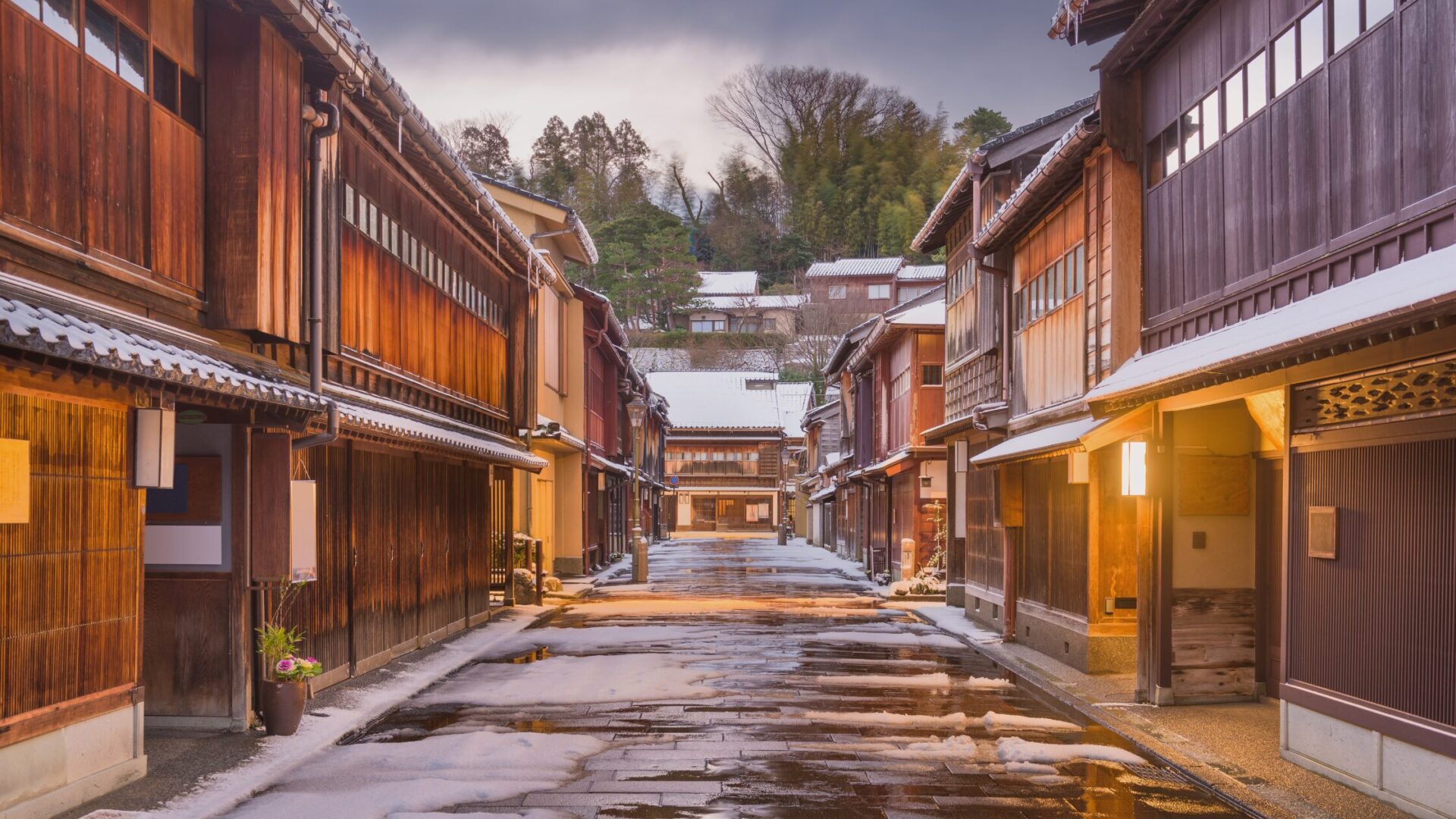

Kanazawa is often described as “the Kyoto of the west” — a city that survived World War II largely unscathed and has kept much of its Edo-period urban fabric intact. The historic geisha districts of Higashi Chaya and Kazuemachi, the samurai quarter of Nagamachi, and the traditional townhouses known as kanazawa machiya are not museum reconstructions. They are living structures, many of which are still in use today.
But “in use” doesn’t happen automatically. Behind each restored townhouse and each traditional inn still serving multi-course kaiseki meals, there are usually local owners, craftspeople, and community networks making deliberate choices to keep these places running — often at a cost that larger commercial operators would not absorb.
This article focuses on six small-scale accommodations in Kanazawa where that kind of local rootedness is visible in the public record. We’re not making claims about which hotel is the “most sustainable.” We’re sharing what we were able to verify from official sources, so you can decide what matters to you when you book.
Related article: Sustainable Hotels in Kanazawa, Japan (2026): 10 Certified and Eco-Conscious Places to Stay
How We Selected These Properties
What “community-rooted” means in this article
For the purposes of this guide, we evaluated properties across six dimensions. We only count a dimension if we found direct evidence on the property’s official website or official tourism listings — not from third-party review sites or our own inference.
- Local ownership and management — Is the property owned or operated by someone based in Kanazawa or Ishikawa Prefecture?
- Local employment — Are local residents employed, and do they have opportunities to grow within the organization?
- Local sourcing — Does the property source food, amenities, or experiences from local producers and artisans?
- Community support — Does the property contribute to local events, community projects, or regional issues?
- Cultural and heritage preservation — Does the property preserve historic buildings, support traditional crafts, or collaborate with traditional performing arts?
- Environmental practices — Does the property reduce energy use, minimize waste, or hold relevant certifications?
Scope: All properties have 30 rooms or fewer. Information is based on official sources available as of 2026. Properties without a verifiable official website were excluded.
What Is a Kanazawa Machiya?
Machiya (町家) are traditional urban townhouses found across Japan, typically featuring a narrow street-facing façade, a long interior floor plan, a latticed wooden front (koshi), and an inner courtyard. In Kanazawa, these structures reflect the city’s distinct Kaga domain aesthetic — a visual language shaped by centuries of patronage from the Maeda clan, Japan’s most powerful feudal lords outside the Tokugawa shogunate.
Kanazawa lost relatively few of these buildings to wartime bombing or postwar redevelopment, which is why the city still has a significant stock of intact machiya. Many are now being converted into guesthouses, restaurants, and shops — a form of adaptive reuse that is central to Kanazawa’s approach to heritage preservation.
The Properties
1. Kanazawa Machiya Guesthouse Akatsukiya
Location: Akemachi, central Kanazawa — about 10 minutes on foot from Kenroku-en Garden and the 21st Century Museum of Contemporary Art
Akatsukiya is a three-room guesthouse housed in a roughly 90-year-old kanazawa machiya. The building is listed as a Registered Tangible Cultural Property (kokutoroku yūkei bunkazai) by the Japanese government — a designation that recognizes structures of historical and cultural value and comes with preservation obligations for the owner.
What we verified from official sources
Akatsukiya holds certification as a Kanazawa SDGs Tourism Promotion Operator — a designation awarded by the City of Kanazawa. The five indicators for which the property received recognition are: “Take care of the earth’s resources,” “Build partnerships across boundaries,” “Respect local communities and nature,” “Protect local culture and the economy,” and “Take on new possibilities.”
Beyond the building itself, Akatsukiya runs agricultural tours (aguri tsua) in collaboration with local farmers, and coordinates fieldwork programs for university students from other prefectures and overseas who come to Kanazawa to learn directly from local residents. The guesthouse functions as a kind of gateway between outside visitors and the local community — something that goes beyond accommodation.
This property may be right for you if you want to engage with local farming and community life, not just observe it from a distance. Or if staying in a certified heritage building is important to you.
Worth knowing before you book
Akatsukiya is a breakfast-not-included property (sujudome), so you’ll arrange your own meals. The historic building structure may limit accessibility for guests with mobility needs — contact the property directly to confirm.
Official site
2. Kanazawa Ryotei Yamanoo


Location: Higashiyama district — on the hillside above Higashi Chaya geisha district, approximately 15 minutes by taxi from Kanazawa Station
Ryotei (料亭) are a distinctly Japanese institution: high-end restaurants that serve elaborate kaiseki multi-course meals in private rooms, with service from trained attendants and, sometimes, geisha entertainers. Yamanoo has been operating as a ryotei since 1890 — its current owner is the fifth generation of the founding family. The food critic and artist Kitaōji Rosanjin, known for his strong opinions about what a meal should be, was reportedly a regular guest.
Yamanoo also accepts overnight guests, making it one of a small number of ryotei in Japan that function as lodging.
What we verified from official sources
Five generations of continuous local family ownership is itself a form of community rootedness that most hotels cannot claim. The cooking draws on seasonal ingredients from Ishikawa Prefecture — from the mountains of the Hakusan range to the Japan Sea coast. Yamanoo also facilitates introductions to geisha entertainment (ozashiki), which supports the continued livelihood of Kanazawa’s geisha community, a form of intangible cultural heritage that requires active patronage to survive.


This property may be right for you if experiencing ryotei culture is the primary purpose of your stay in Kanazawa, and you want the full arc of that experience — arrival, garden, meal, and overnight — in one place.
Worth knowing before you book
Rates start around ¥50,300 per person for one night with two meals included (tax and service charges included). This is the high end of the price range in this guide. The specific number of guest rooms and room configuration are not confirmed in the sources we reviewed — check the official website for current availability.
Book
Ikkyu
 Yahoo!Travel
3. Higashiyama Auberge Makinooto Kanazawa


Location: Higashiyama district — adjacent to Higashi Chaya geisha street
An auberge (オーベルジュ) in the Japanese sense refers to a small inn where the dining experience is central to the stay — the lodging and the restaurant are conceived as a single offering. Makinooto Kanazawa has four rooms across a main building and a detached annex, each designed differently. The restaurant, called Higashiyama Wakon, serves contemporary Japanese cuisine at a counter in an omakase-style format.
What we verified from official sources
The menu is built around Hokuriku-region ingredients — the area of Japan that includes Ishikawa, Toyama, and Fukui prefectures, known for exceptional seafood, rice, and mountain vegetables. For guests staying multiple nights, the property also coordinates reservations at partner restaurants in Kanazawa — including traditional ryotei, sushi counters, and Western-style restaurants. This extends the economic reach of a single stay across several local food businesses.
The property sits within the Higashiyama historic district and maintains architecture and interiors consistent with the neighborhood’s character.

This property may be right for you if food is the lens through which you want to experience Kanazawa, and you want a curated path through the city’s dining culture without having to plan it yourself.
Worth knowing before you book
The operating company is headquartered in Nanto City, Toyama Prefecture — not Kanazawa. It is a Hokuriku-based business, but not strictly a Kanazawa-local one. There are no convenience stores or drugstores nearby; the property’s own website notes that guests should bring anything they need. Energy and waste data are not publicly disclosed.
Book
Ikkyu Expedia
Yahoo!Travel
Expedia
Yahoo!Travel
4. Machiya Whole-House Rental Asanogawa


Location: Kazuemachi district — inside the Kazuemachi Chaya historic preservation area, along the Asano River
Asanogawa is a whole-house rental (ikken gashi) accommodating up to six guests, housed in a 1913 tea-house-style building. The Kazuemachi Chaya district — where it sits — is designated by the Japanese government as an Important Preservation District for Groups of Historic Buildings (Jūyō Dentōteki Kenzobutsu-gun Hozon Chiku). This is one of the highest levels of historic preservation designation in Japan, applied to areas where the overall streetscape, not just individual buildings, is protected.
What we verified from official sources
The property’s stated concept is “to eat what is harvested from this land, to feel people’s daily lives firsthand, and to encounter traditional culture through various experiences.” The official website lists experiences that can be arranged from the property: kinkaku (gold leaf application), Kaga Yuzen (Kanazawa’s distinctive style of hand-painted silk dyeing), Japanese confectionery making, and introductions to ochaya asobi — the traditional form of geisha entertainment at tea houses, which is conventionally off-limits to first-time visitors without an introduction.
Staying in a building within a nationally designated preservation district is itself a form of participation in its conservation.


This property may be right for you if you want a private, whole-house experience in one of Kanazawa’s most intact historic neighborhoods, with flexible access to cultural experiences that would otherwise require local connections.
Worth knowing before you book
Meals are not provided — you will eat out at nearby restaurants in the Kazuemachi area. Details on local sourcing and staffing are not confirmed in the sources we reviewed.
Book
Ikkyu Yahoo!Travel
5. Kanazawa Machiya Inuian

Location: Sanjamachi, central Kanazawa — about 5 minutes by taxi from Kanazawa Station; the Omicho Market and Nagamachi samurai district are within walking distance
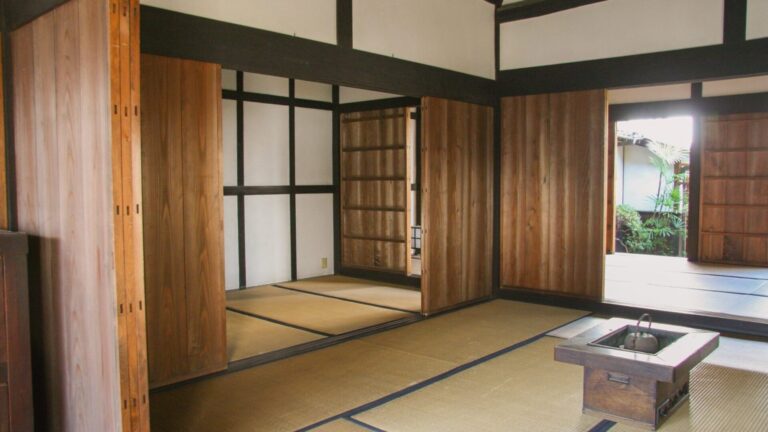
Inuian is a one-group-per-day (ichinichi ikko) whole-house rental occupying a roughly 90-year-old Kanazawa machiya. It holds a formal ryokan business license (ryokan-gyō kyoka), which means it meets the same legal standards as registered hotels and inns. The building retains its traditional interior — shoji sliding screens, wooden furnishings, a garden courtyard — while incorporating a modern IH kitchen, bathroom, air conditioning, and Wi-Fi.
What we verified from official sources
From the official website: “We have worked to restore a precious and beautiful machiya that is disappearing year by year, keeping its traditional character intact while making the space comfortable to stay in.” The property positions itself as a place to “live like a local” rather than to check in and check out.
The property lists an amenity-free option for guests who prefer to bring their own toiletries, which reduces single-use plastic consumption. (Amenities are also available for guests who want them — the choice is left to the guest.)

This property may be right for you if you are traveling as a couple or small family and want a private machiya experience in a central location, with easy access to Kanazawa’s main sights on foot.
Worth knowing before you book
No meals are provided. The property books out quickly, particularly during peak seasons. Detailed information on local sourcing and community programs is limited on the official website.
Book
Ikkyu Expedia
Yahoo!Travel
Rakuten Travel
Jalan
Expedia
Yahoo!Travel
Rakuten Travel
Jalan
6. Guesthouse Ochakare
Location: Kitayasue, western Kanazawa — 5 minutes on foot from Kanazawa Station West Exit (Minato-guchi); 1 minute from Hokutetsu Nanatsuya Station
Ochakare opened in 2012 and is operated by Godo Kaisha Wanaly, a limited liability company registered in Kanazawa’s Kitayasue district. It accommodates up to 16 guests across a combination of private rooms and dormitories, with whole-house rental available. The property has a full kitchen.
What we verified from official sources
Ochakare is operated by a locally registered company — the business address and contact information are in Kanazawa. The official website includes a direct note to guests asking for cooperation with energy and water conservation: “We would appreciate your cooperation with electricity and water saving.” The full-kitchen setup supports self-catering, which reduces dependence on restaurant meals throughout a stay. The property is entirely non-smoking. It works with an adjacent coin parking lot, making use of existing local infrastructure rather than building new facilities.
The common lounge incorporates Japanese ceramics and artwork, giving the shared space a distinctly Kanazawa character.
This property may be right for you if you want a low-cost base in a residential part of Kanazawa — away from the main tourist circuits, close to the station — and you prefer to cook some of your own meals during a longer stay.
Worth knowing before you book
The main sightseeing areas (Higashi Chaya district, Kenroku-en, Nagamachi) require a bus or taxi from this location. Detailed information on cultural preservation activities and local sourcing is not available on the official website.
Book
Expedia
Rakuten Travel
Frequently Asked Questions
What does “community-based hotel” mean in Japan? In the context of this article, it refers to small-scale accommodations where the ownership, staffing, building, or programming has a documented connection to the local community — whether through local ownership, use of locally sourced food, preservation of historic buildings, or collaboration with local artisans and performers. There is no single official certification for this in Japan.
What is a machiya guesthouse in Kanazawa? A machiya guesthouse is a traditional Japanese townhouse (machiya) that has been converted into accommodation, typically small-scale, often retaining the original architectural features — latticed wooden facade, interior courtyard, tatami rooms. In Kanazawa, many of these buildings are over 80–100 years old. Some, like Akatsukiya, are registered as cultural properties.
Is Kanazawa worth visiting for sustainable travel? Kanazawa has one of the highest concentrations of intact historic urban fabric in Japan outside Kyoto, and its relatively small size means that local character is easier to access than in larger cities. The city has an active program recognizing SDGs-oriented businesses in tourism. For travelers interested in cultural preservation alongside environmental responsibility, it offers a more layered experience than many Japanese cities.
What is the Higashi Chaya district? Higashi Chaya (higashi = east, chaya = tea house) is one of three historic geisha entertainment districts in Kanazawa. It dates to the early 19th century, when the Kaga domain consolidated the city’s geisha activities into designated areas. The district retains its original street layout and wooden townhouses. Several of the properties in this guide are located in or adjacent to Higashi Chaya.
What is the difference between a ryotei and a ryokan in Japan? A ryokan is a traditional Japanese inn where guests sleep on futon on tatami floors, typically with meals included and communal or private onsen bathing. A ryotei is primarily a high-end restaurant serving kaiseki cuisine in private rooms, with formal service — some, like Yamanoo, also offer overnight accommodation. The distinction matters because a ryotei stay is organized around the dining experience in a way that a standard ryokan is not.
What is the Important Preservation District for Groups of Historic Buildings in Japan? This is a national designation (Jūyō Dentōteki Kenzobutsu-gun Hozon Chiku, often abbreviated as “Jūden”) applied to areas where the overall historic streetscape has been preserved — not just individual buildings. In Kanazawa, the Higashi Chaya, Nishi Chaya, and Kazuemachi districts all hold this designation. Buildings and street layouts in these areas are subject to strict preservation requirements.
A Note on What We Could and Couldn’t Verify
The properties in this guide were selected because at least one of our six evaluation dimensions could be confirmed from official sources. That means the guide is shaped by what gets disclosed publicly — which varies considerably across properties.
Akatsukiya has the most detailed public record of community engagement, reflected in its SDGs certification and program descriptions. Yamanoo has the deepest historical record of local continuity. Asanogawa has the strongest heritage designation of any property in the guide. Inuian is the most explicit about the preservation mission behind its existence. Makinooto has the clearest food-sourcing orientation. Ochakare has the most transparent local business structure.
What we couldn’t verify from public sources: details on staffing ratios, specific supplier relationships, energy consumption data, and the extent of most properties’ direct community involvement. If those details matter to your decision, we recommend contacting the properties directly.
Closing Thoughts
The six properties in this guide represent six different answers to the same underlying question: what does it mean for a hotel to be part of a city rather than just located in one?
A government-certified heritage building running agricultural tours. A fifth-generation ryotei that has never left its hillside. A tea-house building inside a nationally designated preservation district. A townhouse restored to be lived in, not just looked at. An auberge threading its guests through the local food economy. A guesthouse asking you to turn off the lights.
None of these is a complete picture of what sustainable hospitality could be. But each one is a legible commitment — something you can look up, evaluate, and decide whether it aligns with what you’re looking for.
Kanazawa has enough intact history that the question of who maintains it, and how, is still an open one. Choosing where you stay is one small way of being part of that answer.
Information in this article is based on official sources verified as of 2025–2026. Rates, availability, and program details are subject to change. Please confirm current information directly with each property before booking.