
“Sustainable hotel” is a phrase you’ll see on almost every travel site these days, and it doesn’t always mean the same thing. Kagawa Prefecture, the smallest prefecture in Japan and the gateway to the Seto Inland Sea, is an interesting place to test that phrase. Some municipalities here, including Shodoshima Town and Marugame City, have been publicly associated with international sustainable-tourism recognition programs — though we’d encourage checking the current status directly with Green Destinations or the municipalities themselves rather than taking that at face value from this article alone.
Still, once you start looking closely, “sustainable” turns out to mean very different things from one property to the next. Some hotels hold formal third-party certifications. Others simply describe their own efforts without external verification. Others are built around a completely different model: locally owned, locally financed, and designed to keep tourism revenue circulating within the community rather than flowing out to an outside investor.
This guide is based only on information we could verify directly — official hotel websites, municipal announcements, and company press releases, checked as of July 2026. We’re not ranking these hotels against each other, and we’re not telling you which one to book. Think of this as raw material for figuring out what actually matters to you on this trip. It’s also completely fine to read this and book none of them.
Our Selection Criteria
We narrowed this list down using four criteria. The bar is “can this be confirmed in official, publicly available information,” not “is this hotel actually more sustainable than one that isn’t listed here.” A hotel not appearing in this guide doesn’t mean it isn’t doing meaningful work — it may just mean that work isn’t documented in a way we could verify.
- Third-party certification — Does the property hold a recognized sustainability certification for accommodations, such as Sakura Quality (an ESG-focused standard recognized under the Global Sustainable Tourism Council framework) or Japan’s official Eco Mark?
- Transparency of disclosure — When a hotel calls itself “sustainable” or “eco-friendly,” can you actually trace that claim back to a certification name, a specific program, or a documented local partnership?
- Environmental practices — Are there concrete, named initiatives: energy efficiency upgrades, solar power, waste reduction, plastic-free amenities, water conservation?
- Community and cultural engagement — Does the hotel source local food, support traditional crafts, restore old buildings (kominka), or work with local residents and businesses in a documented way?
All information below reflects what was publicly available as of July 2026. Certifications, in particular, can lapse or be renewed, so if a specific credential matters to your decision, it’s worth checking the current status directly with the hotel or the certifying body.
One more note on how to read the “Where This Falls Short” sections below: when we say something “wasn’t confirmed” or “wasn’t found in official sources,” that means exactly that — we didn’t find it in the sources we checked, not that the hotel definitely isn’t doing it. Some of these practices may be documented in brochures, social media, or municipal partnership pages we didn’t have access to. If something matters to you, it’s always worth asking the hotel directly.
The Hotels
Takamatsu
1. Takamatsu Kokusai Hotel


Location | Kita-machi, Takamatsu City (central Takamatsu)
About the property
A long-established hotel that opened in 1964, the year of the Tokyo Olympics. It’s operated by Anabuki Enterprise.
Sustainability practices
This is one of the more thoroughly documented hotels on this list. Eco Mark certification for hotels and ryokan (Version 2) is listed in the Eco Mark registry under certification number 19 503 007. On the property side, the hotel’s own materials describe running mottECO, a national food-waste-reduction program that lets guests take home leftovers from restaurants and banquet halls; offering plaloop toothbrushes and hairbrushes made from recycled plastic (Eco Mark’s general materials support recycled-plastic amenity concepts like this, though we couldn’t independently confirm the exact collection-and-recycling loop at this specific property); replacing in-room bottled water with refill stations and reusable eco-tumblers; participating in TABLE FOR TWO, an international hunger-relief program; sourcing food locally; and offering a 24-hour EV charging station on-site.

Who this might suit
Travelers who want a government-recognized third-party certification (Eco Mark is administered by Japan’s environmental authority) rather than a self-reported claim, and anyone interested in concrete food-waste and plastic-reduction programs.
Where this falls short
Some third-party media outlets describe this hotel as also holding Sakura Quality certification, but we couldn’t confirm that on the official website. Also worth noting: the parent company disclosed a ransomware incident in 2026, which may have affected some in-house digital services (like check-in kiosks).
Book
2. Royal Park Hotel Takamatsu


Location | Kawaramachi, Takamatsu City (near Kotoden Kawaramachi Station)
About the property
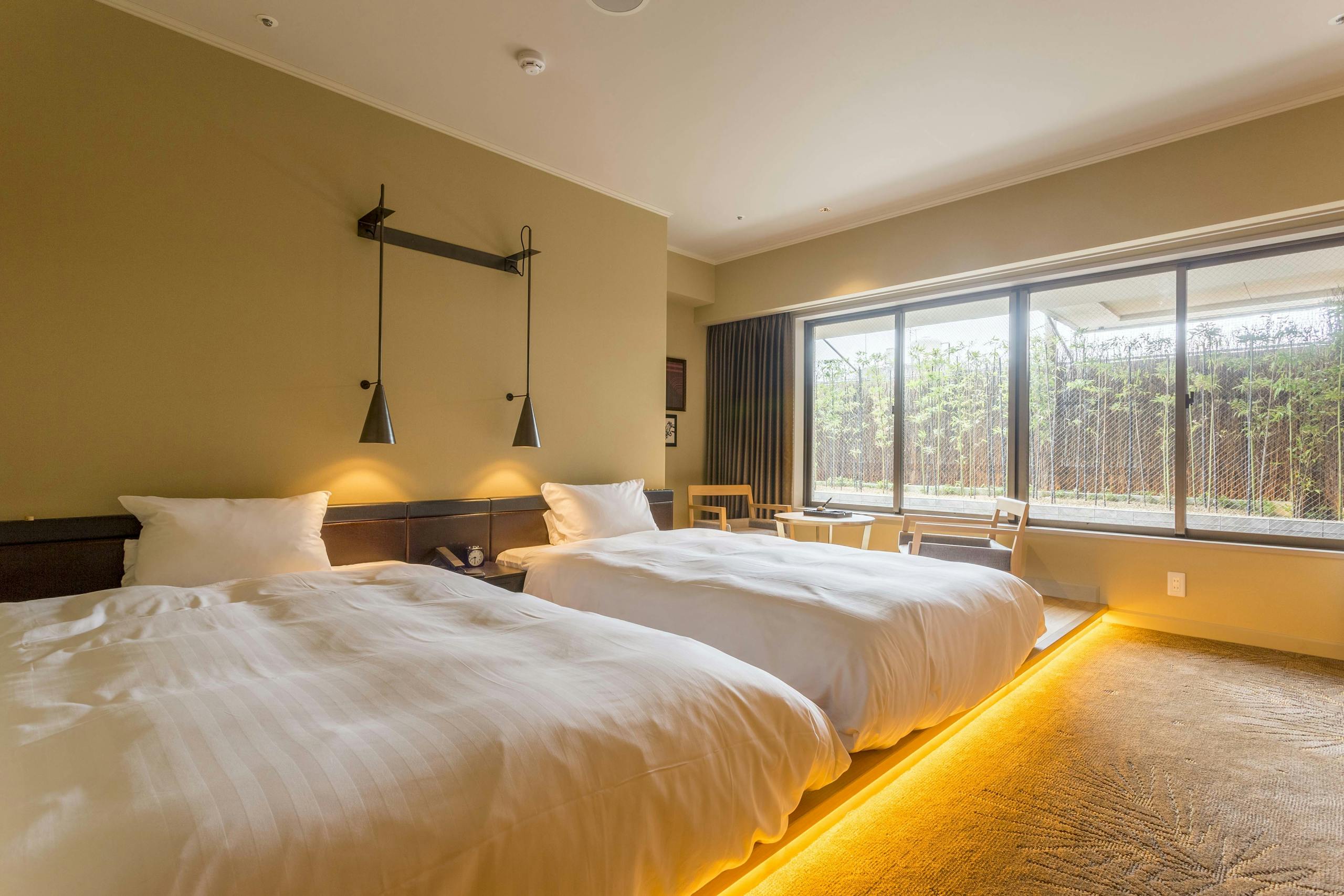
A city-style designer hotel — Shikoku’s first with an all-club-floor concept — with interiors by spatial designer Ryo Takarada.
Sustainability practices
Confirmed on the official site and news page: the hotel adopted mottECO (the food-waste takeaway program) in February 2025 and joined the mottECO Promotion Consortium, a public-private partnership; introduced plaloop recycled-plastic toothbrushes and hairbrushes in November 2024; switched bath amenities to refillable pump bottles instead of single-use bottles; moved mineral water to aluminum cans; and sources food locally. Some listings for this hotel also mention recognition from Kagawa Prefecture related to plastic-waste reduction, though we couldn’t confirm that specific claim directly with the prefecture.

Who this might suit
Anyone who wants proof that food-waste reduction is a documented, ongoing program rather than a one-off gesture, and travelers who want design-forward accommodation alongside environmental measures.
Where this falls short
Some sources mention specific details — biomass razors blended with rice husks and corn starch, a 96.6% aluminum recycling rate, Sakura Quality certification — that we didn’t find on the official pages we reviewed. Since specific numbers and certifications change over time, it’s worth checking directly with the hotel if these details matter to you.
Book

Shodoshima Island
3. Shodoshima Kokusai Hotel
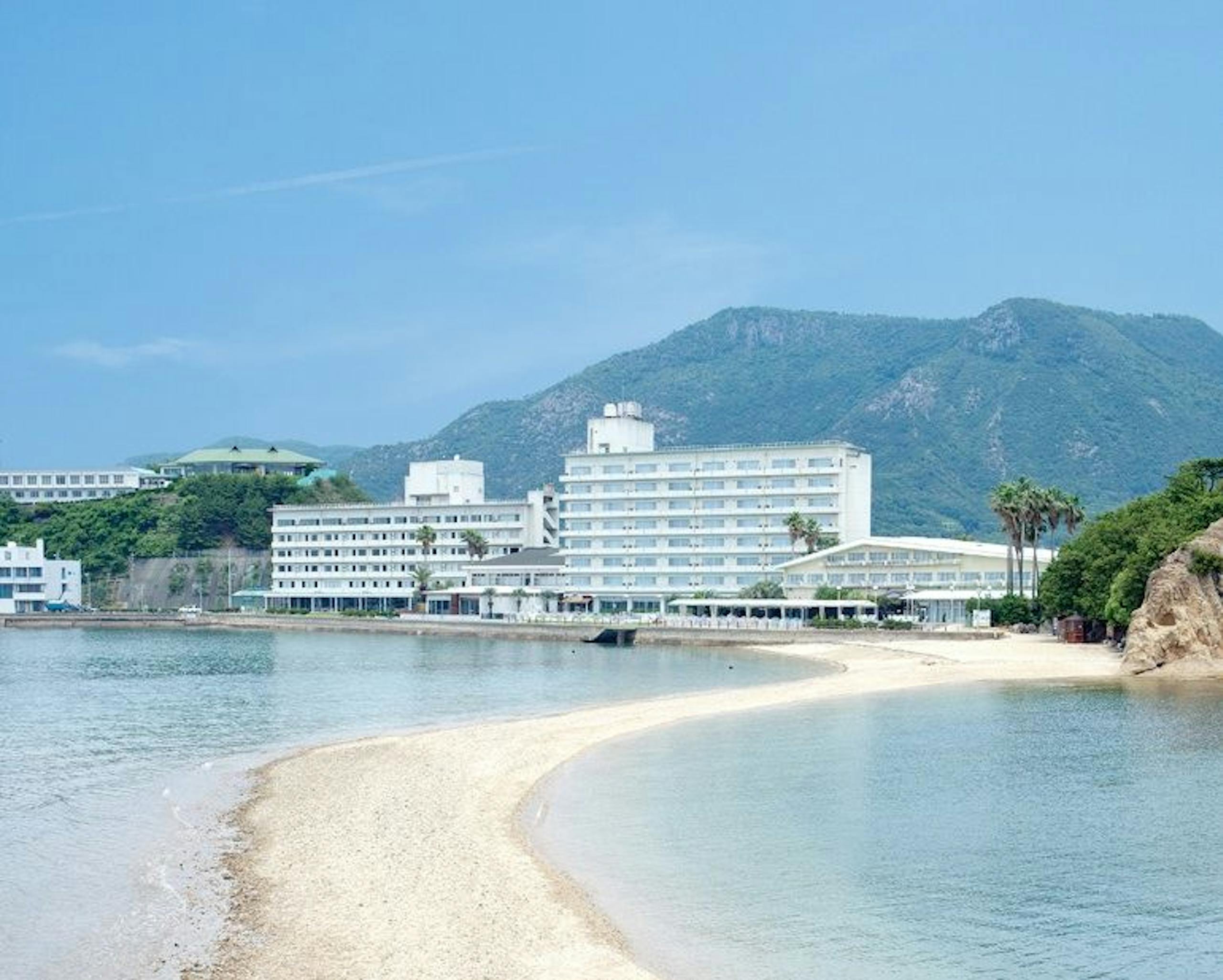
Location | Tonosho, Shodoshima Island, right next to Angel Road
About the property
One of the largest seaside resort hotels on Shodoshima, located next to Angel Road, a sandbar known locally as a spot for couples (it’s said that if you cross it holding hands, your wish will come true).
Sustainability practices
The hotel’s official SDGs page outlines its commitment to “four challenges toward a sustainable society” and confirms that plastic amenities in guest rooms and communal baths are being phased into eco-friendly materials, alongside a push toward reuse over single-use.


Who this might suit
Travelers using Shodoshima as a base for sightseeing (Angel Road is a major draw), and anyone who prioritizes hotels with large communal baths or open-air baths.
Where this falls short
Some commonly repeated stories about this hotel — monthly staff volunteer cleanups of Angel Road, support for reviving abandoned olive farmland, or a formal policy on hiring international staff and interns — weren’t found on the official SDGs page we reviewed.
Book

4. Bay Resort Hotel Shodoshima


Location | Shodoshima Town, along Uchinomi Bay
About the property
An all-ocean-view onsen resort, operated by the same “Angel Resort Group Shodoshima” as the Shodoshima Kokusai Hotel above.
Sustainability practices
Confirmed on the official site: a buffet featuring shoyu-lees (moromi) shoyu and handmade tofu, a kaiseki dinner built around local ingredients, and an amenity bar in the lobby where guests choose what they need rather than finding a full set pre-placed in every room.

Who this might suit
Anyone interested in Shodoshima’s food culture — the island has been producing soy sauce and olive oil for centuries — and travelers who’d rather skip over-packaged in-room amenities.
Where this falls short
A specific “skip housekeeping/skip linen change” incentive program wasn’t found on the official site. Physical accessibility features (wheelchair loans, handrails in the bath area) show up in third-party travel agency listings, but we couldn’t confirm the specific Japan Tourism Agency “Universal Tourism / Heart’s Barrier-Free” accreditation on the hotel’s own site.
Book

5. Shimayado Mari


Location | Shodoshima Town, in the “Hishio no Sato” (Soy Sauce Village) district
About the property
An eight-room ryokan in a district that has been producing soy sauce for over 400 years — the name Hishio no Sato literally means “Village of Fermented Sauce.”
Sustainability practices
Confirmed on the official site: the ryokan’s signature “shoyu kaiseki” course built around local soy sauce and moromi; a guided tour of a soy sauce brewery using traditional wooden-barrel fermentation (offered on weekdays, June to August); a hands-on workshop space called “Sanpusha” that connects local producers directly with guests, including an olive oil cellar sourced from farmers on the island; and a dining hall in the ryokan’s historic main house (“Moya”), which the property describes as a traditional, decades-old building. (We saw this described elsewhere as a registered Tangible Cultural Property, but we’d recommend checking the property or the relevant cultural-property registry directly before treating that legal status as confirmed.)


Who this might suit
Travelers who want to experience Shodoshima’s food heritage — soy sauce, olive oil — through a hands-on, story-driven stay rather than just a meal, and anyone drawn to traditional Japanese architecture.
Where this falls short
Claims about Sakura Quality certification, driftwood upcycling, and a traditional charred-cedar (yakisugi) exterior finish weren’t found on the official site.
Book
Marugame & Kotohira
6. Oedo Onsen Monogatari Hotel Reoma no Mori
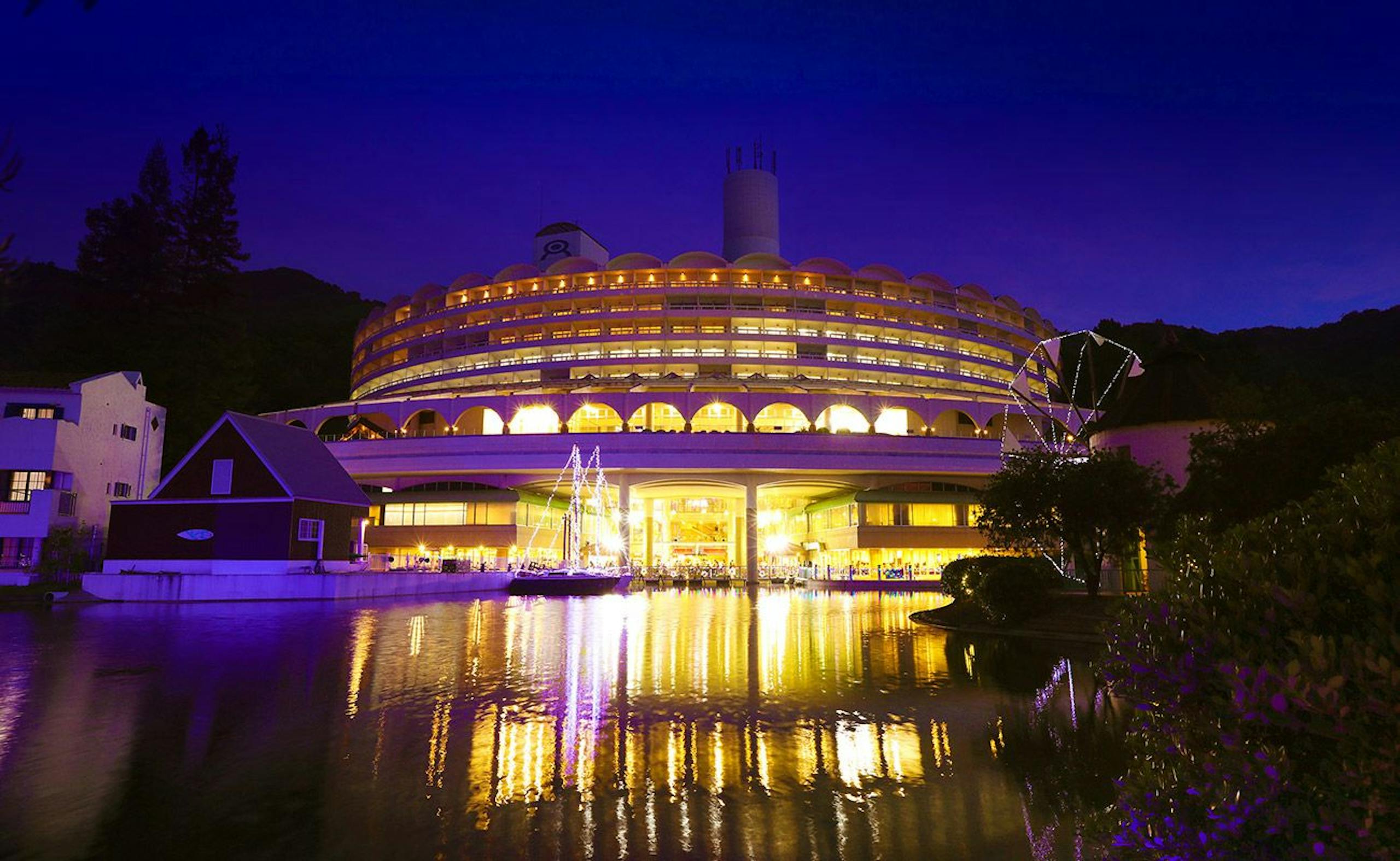
Location | Ayauta-cho, Marugame City, next to NEW Reoma World theme park
About the property
A large-scale leisure hotel combining onsen, buffet dining, and a theme park. This property has been cited in connection with Marugame City’s recognition under an international sustainable-tourism program, though we’d recommend confirming the current status directly with Green Destinations or the city.
Sustainability practices
A regional news outlet, Sanyo Shimbun Digital, reported — citing the operator — that food waste from the buffet restaurant is collected by a specialized contractor and turned into fertilizer, which is then used in an “edible garden” inside the adjacent NEW Reoma World theme park to grow herbs and vegetables served back at the hotel’s WOOLIE’s Restaurant, forming a closed-loop food recycling system. We’re citing this as secondary reporting rather than a direct official statement, since we couldn’t locate the operator’s own press release describing the program.

Who this might suit
Travelers who want the onsen-buffet-theme park combination but are curious about how a large-scale property handles food waste at scale.
Where this falls short
This property’s story is really about circular tourism specifically — we couldn’t confirm any third-party sustainability certification, such as Sakura Quality, for this hotel.
Book
7. Kotohira Grand Hotel (Sakura no Sho / Koubaitei)
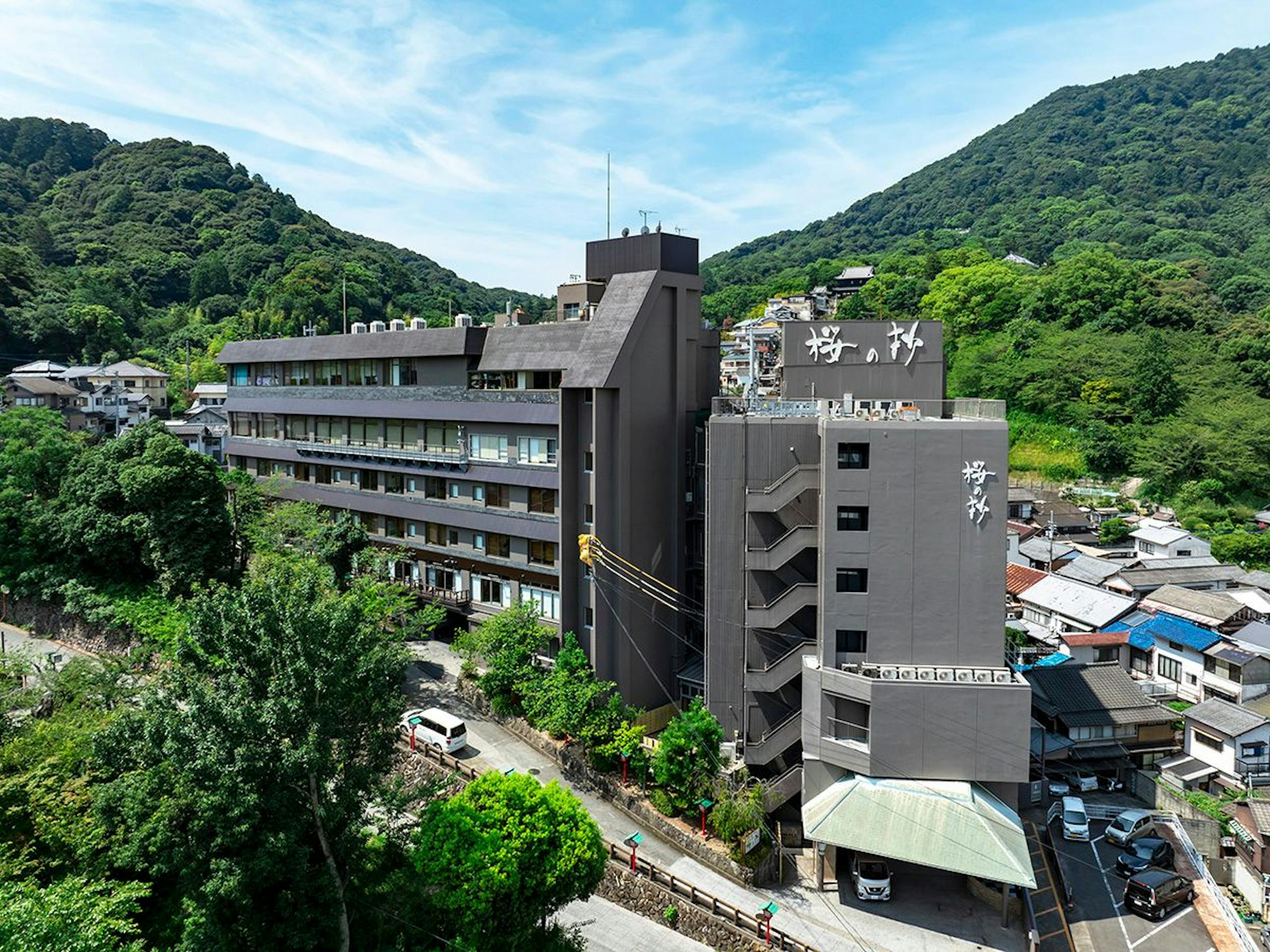
Location | Kotohira Town, on the approach to Kotohira-gu Shrine (Konpira-san)
About the property
A pair of sister onsen ryokan located on the 22nd step of the long stone approach to Kotohira-gu, one of Japan’s most-visited Shinto shrines (over 1,300 steps to the main shrine — locals and repeat visitors sometimes joke about it).
Sustainability practices
The official site documents an accessible, universal-design room at Sakura no Sho. (Third-party listings date this to March 2023, but we couldn’t confirm the exact date on the hotel’s own site.)

Who this might suit
Travelers planning their stay around a visit to Kotohira-gu, and anyone specifically looking for a barrier-free room.
Where this falls short
Honestly, this is the property on our list with the thinnest documented sustainability information — really just the accessible room. We couldn’t confirm claims about EV chargers, a jointly developed retort curry made with local Konpira garlic, or Sakura Quality certification on the official site. One thing worth flagging: the “sustainability” tab that shows up on this hotel’s listing on a major booking site is a standard tab applied to every hotel listing on that platform — it’s not evidence of anything specific to this property.
Book
Mitoyo
8. URASHIMA VILLAGE

Location | Takuma-cho, Mitoyo City, on the Shonai Peninsula
About the property
A collection of standalone villas near Chichibugahama Beach, run by “Setouchi Village Co.” — a consortium of eleven local businesses that pooled their own capital to build and operate the property.
Sustainability practices
The official site describes a solar-plus-certified-power supply model aimed at fully renewable operation: rooftop solar panels supply the majority of the property’s electricity, with the remainder covered by certified non-fossil-fuel power. Buildings are constructed with locally sourced timber using yakisugi, the traditional Japanese technique of charring cedar boards for weatherproofing without chemical treatment. The ownership structure itself is also documented on the official site: eleven local businesses — including a supermarket, a lumber yard, a furniture maker, a construction firm, a bus company, and a car rental company — invested together rather than bringing in outside capital.

Who this might suit
Travelers who want to see a concrete renewable-energy setup rather than a general claim, anyone interested in community-owned tourism models that keep revenue local, and people looking for a villa-style, workation-friendly stay.
Where this falls short
Some specific details circulating elsewhere — two Tesla Powerwall battery units, a total solar capacity of 20.79kWp, or a 2021 Wood Design Award from Japan’s Forestry Agency — weren’t found on the official site.
Book

Naoshima Island
9. Naoshima Ryokan Rokka

Location | Naoshima Town, within walking distance of the Honmura district
About the property
Naoshima is famous worldwide as an art island — home to institutions like the Chichu Art Museum and large-scale outdoor installations. Rokka, which opened in 2022, was the island’s first full-scale Japanese ryokan. It has 11 suite-style rooms.
Sustainability practices
Confirmed via the certifying body’s own notice: this ryokan holds Sakura Quality “An ESG Practice” certification. (We saw a specific “3 Gyoiko Zakura” tier mentioned elsewhere, but couldn’t confirm that particular level on the certifier’s own registry, so we’re leaving it out here.) On its own official site, the ryokan documents its use of regionally sourced natural materials — thinned cedar and cypress timber from Okayama, handmade washi paper from Kyoto, granite from Naoshima itself, and Aji stone quarried in Kagawa. It also describes restoring the hillside behind the property (through selective thinning) and converting it into a working garden, where vegetables are grown without pesticides or fertilizer and served to guests. Guest robes are made from 100% organic cotton, produced in collaboration with the apparel brand iori products.


Who this might suit
Travelers who specifically want to confirm a third-party certification before booking, anyone combining a contemporary art visit with a traditional ryokan stay, and people interested in regional, natural building materials.
Where this falls short
A stated “four pillars” framework (clothing, food, housing, mountain) wasn’t found on the pages we reviewed, nor was a specific program that repurposes old guest robes into new products using traditional plant-dye techniques.
Book

10. Benesse House

Location | Naoshima Town, Kotobiki-chi
About the property
Opened in 1992, Benesse House is a museum and hotel in one building, entirely designed by architect Tadao Ando.
Sustainability practices
This is the most thoroughly documented property on this list. The official sustainability page states that the hotel converted 100% of its lighting to LED starting in 2014 (fully phasing out incandescent bulbs), upgraded air conditioning and elevators with inverter technology, gradually replaced heavy-oil boilers with electric ones, and installed a demand-monitoring system paired with thermal storage tanks that shift energy use to off-peak, cheaper nighttime electricity. On the water side, the property uses an on-site sedimentation pond for circulating water, a membrane filtration system for wastewater, and recycles rainwater collected in underground pits for water features on the grounds. Guests can also opt out of daily housekeeping and linen changes during multi-night stays.

Who this might suit
Travelers who want specific years and mechanisms behind an environmental claim rather than a vague statement, and anyone interested in staying somewhere that combines a working museum with a hotel.
Where this falls short
Claims about cruelty-free THANN amenities, a program that turns discarded acrylic panels into keychains, HACCP food-safety certification, and joint disaster-preparedness drills with island residents weren’t found on the pages we reviewed — though they may appear elsewhere on the site.
Book
Kannonji
11. Hotel Sunny Inn

Location | Kannonji City, near JR Kannonji Station
About the property
A business hotel located right by Kannonji Station.
Sustainability practices
Confirmed on the hotel’s official SDGs page: a public SDGs declaration, LED lighting throughout the building, solar power generation on-site, a housekeeping-check system that reduces unnecessary laundering during multi-night stays, and a shift to refillable amenity dispensers. On the local side, the hotel highlights the use of regional ingredients — including honetsukidori (a Kagawa specialty of bone-in chicken), iriko (dried sardines), and local fish cakes — and displays work by local Kannonji artists. The hotel also uses automated check-in kiosks and follows HACCP-based hygiene management.

Who this might suit
Travelers using Kannonji as a base, and anyone who wants a direct connection to local food and local artists during their stay.
Where this falls short
We couldn’t confirm any third-party certification — GSTC, ISO 21401, or Sakura Quality — for this property.
Book
What to Check Before You Book
If you want to dig deeper into any of these properties, a few starting points:
- Certification details and current status are worth checking directly on the certifying body’s own site, not just the hotel’s — Sakura Quality (sakuraquality.com) and Eco Mark (ecomark.jp) both maintain public information.
- A “sustainability” tab on a booking platform isn’t necessarily specific to that property — as noted for Kotohira Grand Hotel above, some booking sites display a standard tab on every listing. Click through and check whether the content is actually specific before assuming it means something.
- If you’re weighing a certification (like Eco Mark or Sakura Quality) heavily in your decision, note that certifications can lapse or be renewed. What we confirmed reflects July 2026 — check current status if it’s a deciding factor.
For anything not covered in this guide, or updates after publication, we’d recommend checking each hotel’s official website and the certifying bodies’ public registries directly.
Which Hotel Fits Your Trip?
Each of these 11 hotels approaches sustainability from a genuinely different angle. Of the eleven, the two where we could directly verify a named third-party certification against the certifier’s own materials are Takamatsu Kokusai Hotel (Eco Mark) and Naoshima Ryokan Rokka (Sakura Quality). That’s a reflection of what we could verify in the sources we checked, not a claim that no other property on this list holds any certification at all.
If you care about seeing a concrete renewable-energy setup rather than a general claim, URASHIMA VILLAGE documents its solar-and-grid-power arrangement directly. If you want the most detailed, dated record of environmental upgrades over time, Benesse House has published specifics going back to 2014. Oedo Onsen Monogatari Hotel Reoma no Mori is built around a closed-loop food recycling system rather than certifications, and Shimayado Mari centers its story on a 400-year-old local soy sauce tradition.
Which of these matters more to you — a certification you can verify, a specific mechanism you can picture, or a connection to local history and food culture — probably says as much about what you want from this trip as it does about any individual hotel. We hope this guide gives you enough to work that out for yourself.
This guide is based on each hotel’s official website, municipal announcements, and company press releases, as confirmed as of July 2026. Details may change without notice. For the most current information, check each property’s official website directly.