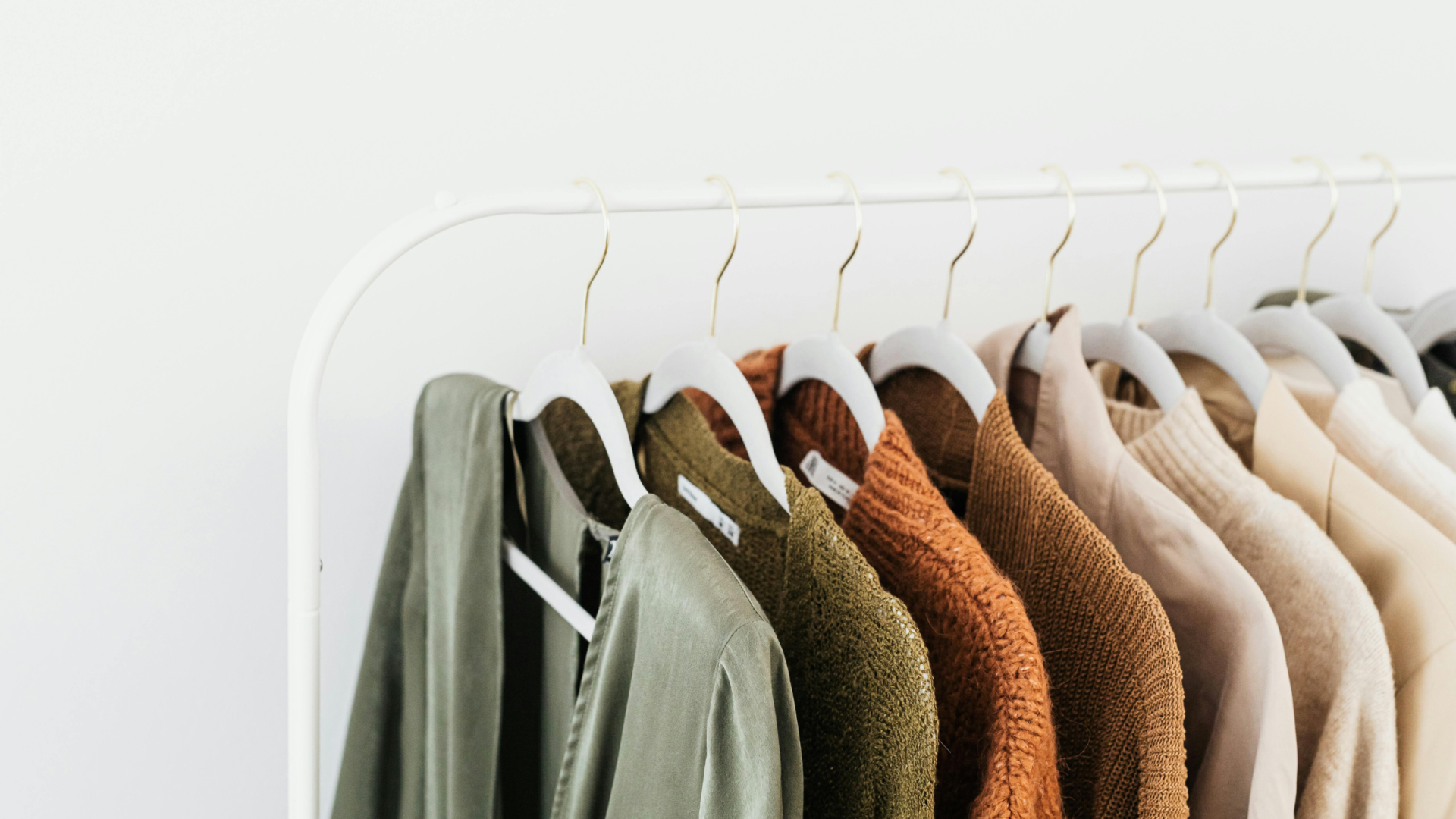

Since I started trying to live as a minimalist, everything I own fits on one clothing rack and in one storage box. So I’ve never done koromogae (衣替え), Japan’s custom of packing away one season’s clothes and bringing out the next. The usual dates are June 1 and October 1.
This autumn, I’ve been thinking about adding a few pieces. That’s where I got stuck. If I add something, what should it be so that everything still fits on that rack?
Owning fewer clothes can sound like a matter of throwing things out. But how many clothes you need depends on something else: whether each piece works in only one season. Koromogae assumes it does, with one set of clothes for summer and another for winter.
Below, I look at what koromogae takes for granted, using its history and Japan’s temperature data. Then I look at which clothes can carry you across seasons, by fabric and by layering. Last, I look at how to cut down and what owning fewer clothes means for the environment.
Own fewer clothes by choosing pieces that work across seasons
There are two ways to dress for Japan’s seasons. One is koromogae: you own a separate set of clothes for each season and swap them when the season turns. The other is to build your wardrobe around pieces that work across seasons, and cut it down until everything fits in one place.
I do the second. I don’t need a second set, so my wardrobe stays small. When the season turns, I just change how many layers I wear.
So if you add something, pick a piece you can layer.
Two chores remain. Wash clothes before you set them aside for a while, and fold anything that stretches on a hanger, like knits.
What koromogae takes for granted
Koromogae assumes two things: the season changes on a fixed date, and you own a separate set of clothes for each season. The first one is drifting out of step with Japan’s climate. The second one decides how many clothes you own.
June 1 and October 1 date from Meiji-era uniforms
The custom of switching clothes on June 1 and October 1 spread after Japan adopted Western-style uniforms in the Meiji era. Before that, the dates and the number of changes a year were different.
One record of court ceremonies, the Kenmu Nenchū Gyōji, is traditionally attributed to Emperor Go-Daigo. It describes the imperial court changing clothes on April 1 and October 1, by the old lunisolar calendar.
By the Edo period, people changed clothes four times a year. From April 1, they wore a lined kimono (awase). From May 5, they switched to an unlined one (katabira). On September 1, they went back to the lined kimono, and from September 9, they wore one padded with cotton wadding.
The custom assumed you owned kimono made differently for each season. Koromogae was the day you swapped one set for the other.
When the Meiji government adopted Western-style uniforms, wearing summer uniforms from June 1 and winter uniforms from October 1 became common practice (Okayama Prefectural Library, 2017).
It’s unclear whether any law ever set these dates nationwide. Today, schools and companies in Japan each follow their own rules.
By October 1, the season hasn’t changed yet
In Tokyo, the normal high on October 1 is 24.5°C (76.1°F). The Japan Meteorological Agency calls a day that reaches 25°C (77°F) or higher a natsubi, or “summer day.” So October 1 falls just short of one. The normal high only drops to 19.6°C (67.3°F) by October 31 (Japan Meteorological Agency, “Daily normals”).
These normals are averages for 1991 to 2020, and October has kept getting warmer since. According to the agency, Japan’s average October temperature has risen at a rate of 1.53°C per 100 years. The warmest October on record was in 2024, and the second warmest was in 2025 (Japan Meteorological Agency, “October temperature anomalies”).
Some schools don’t switch on the calendar date. In 2024, Higashimurayama-Nishi High School, a Tokyo metropolitan high school, set a transition period from October 2 to October 25. Its notice to parents explained, in my translation, “The calendar says it’s time for the seasonal uniform change, but in consideration of heatstroke prevention and other factors…” (Tokyo Metropolitan Higashimurayama-Nishi High School, 2024).
A summer set and a winter set leave a gap in October. Clothes that work across seasons fill it.
Fabric and layering decide whether a piece can cross seasons
To own fewer clothes, choose pieces you can layer over pieces that only work in one season. Fabrics differ in two ways that matter here. One is how much moisture they absorb. The other is how likely insects are to eat them while they sit unworn.
Cotton, linen, wool, and synthetics differ in moisture and moth damage
It would help to know which fabric suits which temperatures. But I couldn’t find any standard that sets a temperature range for each fabric.
The clearest difference is moisture. Under the same temperature and humidity, wool holds nearly twice as much moisture as cotton, and about 40 times as much as polyester (HVAC Systems Encyclopedia).
The second is insect damage. The larvae of clothes moths and carpet beetles feed on animal materials such as wool, silk, feathers, and leather. They also go for clothes stained with food or body oils (Wright, 2001).
| Fabric | How much moisture it absorbs | Food for clothes moths? |
|---|---|---|
| Wool | A lot | Yes (animal fiber) |
| Linen | A lot | Not a main food source |
| Cotton | A moderate amount | Not a main food source |
| Polyester and other synthetics | Very little | Not a main food source |
If you keep every season’s clothes out all year, keep a close eye on wool. It stays in your closet all summer without being worn, so clean it when you stop wearing it in spring.
Add and remove layers to cross the seasons
Much of a garment’s warmth comes from the air trapped between its fibers. Fibers conduct heat 5 to 20 times more readily than air, so the air does more to hold heat in (Rogale et al., 2023).
Air isn’t trapped only inside yarns and fabrics. Layer thin clothes, and a layer of air forms between one garment and the next.
With a small wardrobe, you add or remove layers when the weather changes. On a cool morning, put something over a short-sleeved top, and take it off when the afternoon warms up. When it gets colder, swap the short-sleeved top for a long-sleeved one.
A heavy coat that only works in winter brings the seasonal swap right back.
Wash clothes before setting them aside, and fold your knits
Owning fewer clothes doesn’t change the basic care. Wash clothes before you set them aside for a while.
Dirty clothes are more likely to attract insects (Wright, 2001). Even if insects stay away, sweat and body oils oxidize over time. That can discolor fabric and weaken fibers until they break (Canadian Conservation Institute).
Fold your knits instead of hanging them. On a hanger, their weight pulls on the shoulders and neck, and the knit stretches out of shape (U.S. National Park Service, 2020).
These tips come from a U.S. university guide and from conservation guidelines for museum textiles in Canada and the United States.
Cut down to what fits in one place
When your clothes don’t fit, you can add storage or own fewer. If you add storage, you keep as many clothes as you have now. If you cut down, you stop putting clothes away each season.
More storage, or fewer clothes?
| Approach | What you’ll need | How many clothes you keep |
|---|---|---|
| Add storage | Clothing racks, storage cases, a storage unit, and so on | As many as you have now |
| Cut down | Nothing (your current storage) | As many as fit in one place |
Start with the clothes you don’t wear
To see how far you could cut down, look at the clothes you don’t wear. According to a survey by Japan’s Ministry of the Environment, a person in Japan buys about 19 items of clothing a year. Yet each person has about 24 items they didn’t wear even once in a year (Ministry of the Environment).
So more clothes sit unworn in storage than people buy in a year. Adding storage only gives those clothes more room.
Throwing clothes away to cut down won’t reduce their environmental impact, though. If you let clothes go, start by finding someone who’ll wear them next. For where to take them, see sustainable ways to get rid of old clothes in Japan.
Buying fewer new clothes cuts their environmental impact
Most of the environmental impact of clothing happens before it ever reaches a store. So buying fewer new clothes does more to cut that impact than getting rid of the ones you have.
Most of the impact happens before clothes reach the store
Japan’s Ministry of the Environment estimates that making one garment emits about 25.5 kg of CO2 and uses about 2,368 liters of water. Of that CO2, 94.6% comes from the stages before the clothes reach stores, from producing raw materials to shipping (Ministry of the Environment, 2020).
These figures are averages across all the clothing supplied in Japan. They don’t describe the T-shirt in your closet.
Water depends heavily on the fabric. About 90% of it goes into producing raw materials, mostly growing cotton. So the more cotton a garment contains, the more water it takes.
Count only the CO2 emitted inside Japan, and more than 30% comes from the use phase, such as washing and drying. Production isn’t the whole story.
How much does wearing clothes longer help? WRAP, a UK organization working on waste and resources, has put a number on it. Keeping clothes in use for just nine months longer could cut their carbon, water, and waste footprints by up to 20%. The estimate is based on how people in the UK use clothes (WRAP, 2024).
Throwing clothes away doesn’t undo the impact
Throwing a garment out doesn’t undo the impact of making it. What you save is the impact of the clothes you never bought.
In 2020, people in Japan let go of 787,000 metric tons of clothing. Of that, 510,000 metric tons, or 64.8%, was disposed of, and 19.6% was reused (Ministry of the Environment, 2020).
According to the Ministry of the Environment’s current figures, an average of 1,300 metric tons of clothing a day is incinerated or sent to landfill. Reuse and recycling together account for about 42%, but that figure includes exports overseas (Ministry of the Environment).
Once used clothes are exported, it’s hard to know what becomes of them. The European Environment Agency calls the fate of used textiles exported from the EU “highly uncertain.” In 2019, 46% of them went to Africa. What can’t be reused mostly ends up in open landfills and informal waste streams (European Environment Agency, 2023).
I couldn’t find data on what happens to clothes exported from Japan.
Japan’s Ministry of the Environment recommends wearing clothes for as long as you can. When you let them go, look for someone to reuse them first, and send them for recycling if that’s not possible. If you cut down your wardrobe, follow the same order.
Final thoughts
Koromogae rests on two assumptions. The season changes on a fixed date like October 1, and you own a separate set of clothes for each season.
In Tokyo, the first one is already shaky, with a normal high of 24.5°C on October 1. The second decides how many clothes you own, and it’s your choice. Build your wardrobe around clothes you can layer, and one set can carry you across the seasons.
If your clothes don’t fit, I’d suggest owning fewer rather than adding storage. Find new homes for what you let go instead of throwing it away. After that, try not to add more.
Here’s one thing you can do today. Open your closet and count the clothes you didn’t wear even once last autumn. That number shows how far you could cut down.
For clothes you only wear in one season, like a heavy coat, or clothes you rarely wear, renting is another option. Even then, what matters is whether renting keeps the number of clothes at home from growing. For clothing rental in Japan, see this guide to sustainable clothing rental.
Sources
Canadian Conservation Institute. “Caring for textiles and costumes”.
European Environment Agency (2023). “EU exports of used textiles in Europe’s circular economy”.
HVAC Systems Encyclopedia. “Fiber Moisture Pickup”.
Japan Meteorological Agency. “Daily normals: Tokyo, October” (in Japanese).
Japan Meteorological Agency. “October temperature anomalies in Japan” (in Japanese).
Ministry of the Environment, Japan (2020). “FY2020 Survey on Fashion and the Environment” (in Japanese). Japan Research Institute.
Ministry of the Environment, Japan. “Sustainable Fashion” (in Japanese).
Okayama Prefectural Library (2017). “I want to know the history of koromogae” (in Japanese). Collaborative Reference Database, National Diet Library.
Rogale, D. et al. (2023). “Measurement Methods of the Thermal Resistance of Materials Used in Clothing”. Materials (Basel).
Tokyo Metropolitan Higashimurayama-Nishi High School (2024). “Notice on the seasonal uniform change” (in Japanese).
U.S. National Park Service (2020). Conserve O Gram 4/5 “Storage Techniques for Hanging Garments: Padded Hangers”.
WRAP (2024). “Extending Product Lifetimes: WRAP’s Work on Clothing Durability”.
Wright, Susan (2001). “Preventing Damage from Clothes Moths and Carpet Beetles”. New Mexico State University, Guide C-504.