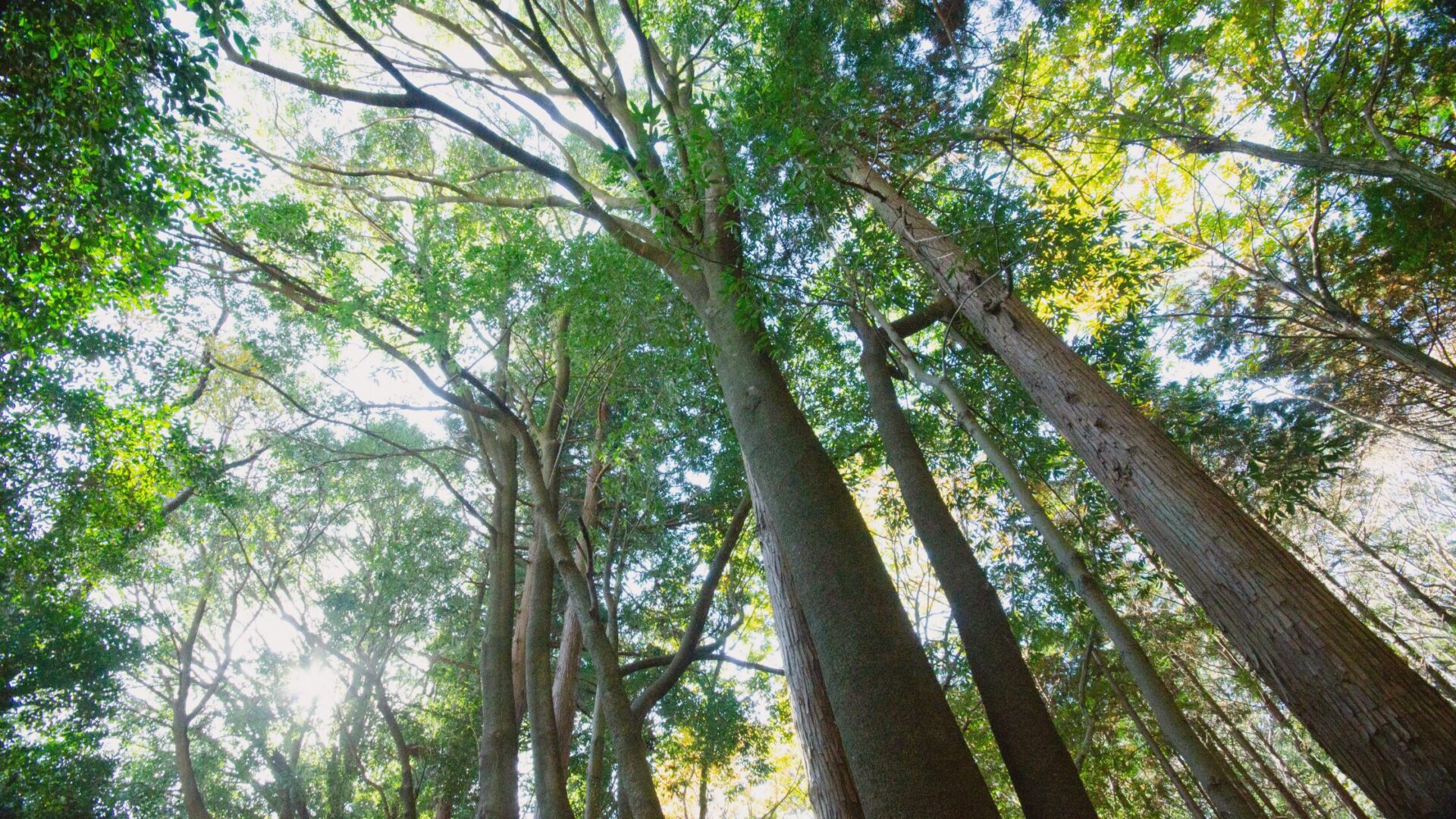

You’ve probably come across the word shinrin-yoku — in a wellness article, a travel guide to Japan, or maybe a conversation about burnout and digital detox. And yet, if someone asked you to explain it, you might hesitate. It sounds like hiking, but it isn’t. It overlaps with mindfulness, but that’s not quite right either.
The fact that the Japanese term shinrin-yoku (森林浴) has traveled around the world untranslated is worth pausing on. Words that resist translation usually carry something that can’t be neatly packaged into another language. This one might be telling us something about where the concept comes from — and why it resonates so widely right now.
This article traces shinrin-yoku from its origins in 1980s Japan through the science that supports it, and into a bigger question: what does it mean that we need a named practice just to spend time in the woods?
What Is Shinrin-Yoku? A Clear Definition
Shinrin-yoku (森林浴) is a Japanese term that translates roughly as “forest bathing.” It was coined in 1982 by Japan’s Forestry Agency (林野庁, Rinyachō) as a way to describe the practice of immersing oneself in a forest environment and absorbing its atmosphere through all five senses — without any particular goal or destination in mind.
The word was modeled on existing Japanese terms: kaisuiyoku (海水浴, sea bathing) and nikkōyoku (日光浴, sunbathing). The same year the term was introduced, Japan’s first official shinrin-yoku event was held at Akasawa Natural Recreation Forest in Nagano Prefecture, which remains one of the country’s most celebrated forest therapy sites today.
Shinrin-yoku vs. forest therapy: The two terms are related but generally understood differently. Shinrin-yoku refers to the broad practice of being in the forest — slow, sensory, without agenda. Forest therapy (shinrin ryōhō, 森林療法) is a more structured, evidence-based framework developed in the 2000s, with certified trails, trained guides, and specific health goals. In practice, the boundary between the two isn’t formally standardized and the terms are sometimes used interchangeably in public communication — but the distinction is analytically useful: shinrin-yoku as cultural concept, forest therapy as its more clinical application.
Where Did Shinrin-Yoku Come From?
Japan’s Forestry Agency introduced the term at a specific moment in Japanese forestry history. The broader policy context — declining timber demand and growing interest in the non-economic functions of forests — shaped the environment in which the concept emerged. Japanese forestry policy from this era increasingly recognized what documents called “multifunctional” forest roles, including recreation and health, though the specific policy motivations behind the shinrin-yoku campaign are not always made explicit in official sources. What is clear is that the concept was introduced as a way to reconnect people with forests for purposes beyond resource extraction.
What began as a cultural campaign became a scientific endeavor. Through the 1990s and especially into the 2000s, researchers at Japan’s Forestry and Forest Products Research Institute began systematically studying what forests do to the human body. The results were significant enough to eventually reach international health discussions.
Today, shinrin-yoku is referenced in WHO materials on nature-based health approaches, alongside other examples of how countries have used green space and natural environments to support well-being. In Europe and the United States, forest bathing has been taken up by wellness practitioners and public health researchers as a low-cost, non-pharmacological complement to mental health support — though its integration into formal clinical practice remains limited and varies widely by country and context. It is not a replacement for medical treatment, but interest in it as a supplementary approach continues to grow.
What Does Forest Bathing Actually Do to Your Body?
The feeling of calm that comes from walking in the woods is real — and it’s measurable. Here’s what research has documented, alongside some honest notes on where the science is still developing.
Phytoncides and the immune system
Trees release volatile organic compounds — including alpha-pinene and limonene — known as phytoncides, as part of their natural defense system. The olfactory system has a relatively direct pathway to the brain regions involved in emotion and memory, which is part of why smell can trigger such immediate physical responses. Researchers have proposed that this pathway is one mechanism by which inhaled phytoncides may influence immune function and the autonomic nervous system.
Immunologist Qing Li and colleagues reported that participants who spent time in forest environments showed increased activity of NK (natural killer) cells and elevated levels of anticancer proteins following forest visits. That said, sample sizes in these studies were small, and questions about reproducibility remain. The findings are promising, but they represent an early chapter in a longer research story.
The autonomic nervous system
Multiple studies have found that forest environments are associated with a shift toward parasympathetic nervous system dominance — the “rest and digest” state — and away from sympathetic activation, the stress response. Japan’s Forestry Agency documented elevated parasympathetic activity in participants who walked forest paths compared to urban streets, under specific experimental conditions. The subjective sense of calm that most people feel in the woods appears to have a measurable physiological correlate: changes in heart rate variability (HRV).
Cortisol reduction
Lower levels of cortisol — the body’s primary stress hormone — have been consistently observed in forest environments compared to urban settings. A 2019 systematic review and meta-analysis found this pattern held across multiple studies, giving it more weight than any single experiment could. The effect size varies considerably between individuals, and researchers caution against overstating the magnitude of the change. Still, the direction of the evidence is consistent.
The point isn’t that forests are magic. It’s that the sense of ease you feel in the woods corresponds to documented shifts in how your body is operating.
Why Do We Need a Named Practice Just to Walk in the Woods?
This is the question worth sitting with.
For most of human history, forests weren’t a destination. They were the background of daily life. The fact that “spending time in the forest” now requires a label, a methodology, and a scheduling decision says something about the distance we’ve traveled.
The sociologist Georg Simmel wrote in 1903 about what city life does to the human nervous system. Constant stimulation, he argued, forces urban dwellers to process the world intellectually rather than emotionally — a protective adaptation that also, over time, blunts sensory experience. Cities, in his framing, train you to calculate rather than feel.
Urbanization has created two kinds of separation from nature. The first is spatial: soil, plants, and ecosystems have been replaced by concrete and asphalt, with nature surviving mainly in managed parks. The second is temporal: human bodies, once synchronized to sunlight and seasons, are now governed by clocks, deadlines, and artificial light.
Smartphones completed what urbanization started. Environmental psychologists Rachel and Stephen Kaplan developed what they called Attention Restoration Theory (ART) to explain what this does to us. They identified two modes of attention: directed attention, which requires conscious mental effort — answering emails, scrolling feeds, managing notifications — and involuntary attention, which is drawn effortlessly toward something genuinely interesting. Digital life consumes directed attention almost continuously, leaving it depleted. The Kaplans found that natural environments, with what they called “soft fascination” — dappled light, rustling leaves, water — activate involuntary attention and allow directed attention to recover.
There’s also what might be called sensory impoverishment. Screen-based life is overwhelmingly visual, and a particular kind of visual: flat, two-dimensional, optimized. This steady diet gradually mutes the other senses — smell, touch, proprioception. Journalist Richard Louv coined the phrase “nature deficit disorder” to capture the health consequences of this disconnection. It’s not a clinical diagnosis, but it has functioned as a productive framework in environmental psychology and public health research, pointing toward a category of harm that’s difficult to name but easy to recognize.
Why Has the West Embraced a Japanese Word for This?
The untranslatability of shinrin-yoku points to something worth exploring.
One way into it is through how the Japanese relationship with nature has been philosophically framed. In certain Buddhist and Daoist-influenced traditions that shaped Japanese thought, the word for nature — shizen (自然) — carries a meaning closer to “that which happens of its own accord” than to the Western sense of nature as external landscape. Some scholars and philosophers have drawn on the concept of jinen (自然 in an older reading) to articulate this: a sense that nature is not something humans stand apart from and observe, but a process they are already inside. This is an interpretive philosophical position, not a simple historical linguistic fact — the word shizen has complex histories in both premodern and modern Japanese usage. But as a way of understanding the cultural assumptions behind shinrin-yoku, it offers a useful contrast.
This sits in sharp contrast to the dominant Western tradition. Post-Cartesian thinking divided the world into mind (the human subject) and matter (the natural object). Francis Bacon’s vision of science as a means of making nature yield to human purposes encoded this separation into the foundations of modern inquiry. Knowing and controlling became synonymous.
The appeal of shinrin-yoku in Western wellness culture may reflect a growing unease with this arrangement. Much of how Westerners typically engage with nature — hiking trails with elevation profiles, trail runs with GPS data, peak-bagging — is structured around achievement. That’s not inherently wrong. But it does reproduce a familiar dynamic: nature as terrain to be covered, mastered, optimized.
Forest bathing asks for none of that. There’s no distance to log, no summit to reach, no output to measure. The practice is fundamentally about being rather than doing — which, for people whose sense of self is tightly tied to productivity, can be surprisingly difficult. And surprisingly necessary.
Norwegian philosopher Arne Næss, whose concept of deep ecology argued for the intrinsic value of all living beings, proposed the idea of an “ecological self” — an expansion of identity to include the ecosystems one belongs to. The felt sense of one’s breathing synchronizing with the rhythm of a forest is, in a way, a physical approximation of what Næss was describing philosophically.
It’s also worth noting that shinrin-yoku connects naturally to sustainability-minded thinking. A culture that sees forests only as timber sources treats them very differently than one that sees them as environments humans are part of and depend on. The practice of forest bathing, at its quietest, is also an argument for why forests deserve to exist.
What Actually Happens When You Open Your Senses
Sight is a distancing sense. It lets you observe something from across the room — or across an ecosystem — without contact. This is part of why vision has been the dominant sense in Western modernity, which placed the human observer firmly outside the natural world being observed.
Smell and touch work differently.
When you breathe in phytoncides, the forest’s chemistry enters your body and travels through your bloodstream. The boundary between inside and outside becomes porous. Smell bypasses much of the cognitive processing that language requires — it reaches you before you’ve formed a thought about it. That’s a different kind of contact than looking.
Walking on uneven ground — roots, mud, stones — activates proprioception in ways that pavement never does. Your body is constantly adjusting its balance and position in response to terrain that doesn’t cooperate. There’s also emerging (though still preliminary) research suggesting that contact with soil bacteria, particularly Mycobacterium vaccae, may support serotonin production. The evidence here is primarily from animal studies, and human data remains limited — this is one to watch rather than take as settled.
Then there’s the quality of light and sound in natural settings. Natural environments are full of what physicists call 1/f fluctuations — patterns that combine regularity and randomness, found in dappled light, flowing water, wind in leaves. Some researchers have proposed that human neural rhythms have a similar structure, and that exposure to 1/f patterns in nature may contribute to a felt sense of ease. This remains a hypothesis rather than established neuroscience, but it offers one explanation for why certain natural environments feel restorative in ways that are hard to articulate.
What forest bathing seems to do, when it’s working, is blur the boundary between body and environment. That’s not mysticism — it’s a description of what happens when senses other than sight are allowed to function.
A Closing Thought
Saying that forest bathing is good for you is probably true. But the research points to something more specific than general wellness.
Human immune function responds to phytoncides. Human attention recovers in environments with soft fascination. Human stress physiology shifts measurably in forests. None of this is accidental. It suggests that connection to non-human environments isn’t a luxury or a lifestyle preference — it’s something closer to a functional requirement.
The fact that we’ve named and scheduled this connection is a sign of how far it has drifted from ordinary life. Urbanization, digital saturation, the relentless pressure to produce — these are the conditions that made “forest bathing” a necessary concept. We didn’t need a word for it until we needed a reminder.
You don’t have to rearrange your life around it. But it might be worth asking: when did you last stand in the woods with no particular goal in mind?
Sources
- Japan Forestry Agency, “Shinrin-yoku — The Forest and You“
- Japan Forestry Agency, Scientific Report on Forest Health Effects (Summary)
- Government of Japan, Highlighting Japan (Aug. 2019)
- Li Q. et al., “Effect of Forest Bathing Trips on Human Immune Function,” PubMed
- Li Q. et al., “Visiting a forest, but not a city, increases human natural killer activity,” PubMed
- “Effect of forest bathing on physiological and psychological responses,” ScienceDirect
- WHO IRIS, Shinrin-yoku reference document
- Forest Therapy Society (English)