
A coffee cup I used every morning chipped. Just the rim, just a small piece.
It wasn’t an expensive cup. But I couldn’t bring myself to throw it away. Standing there with the broken piece in my hand, something made me pause — not quite loss, not quite reluctance. Something else.
I’d heard the word kintsugi before. I thought I knew what it meant: broken pottery fixed with gold. But when I started learning the technique myself — mixing lacquer, waiting days for it to dry, layering it again — I realized the word carried more than a repair method. It carried a whole way of seeing what broken things can become. This article traces that idea: what kintsugi is as a craft, why its philosophy resonates so widely right now, and what it might tell us about the relationship between sustainability and beauty.
What Is Kintsugi?
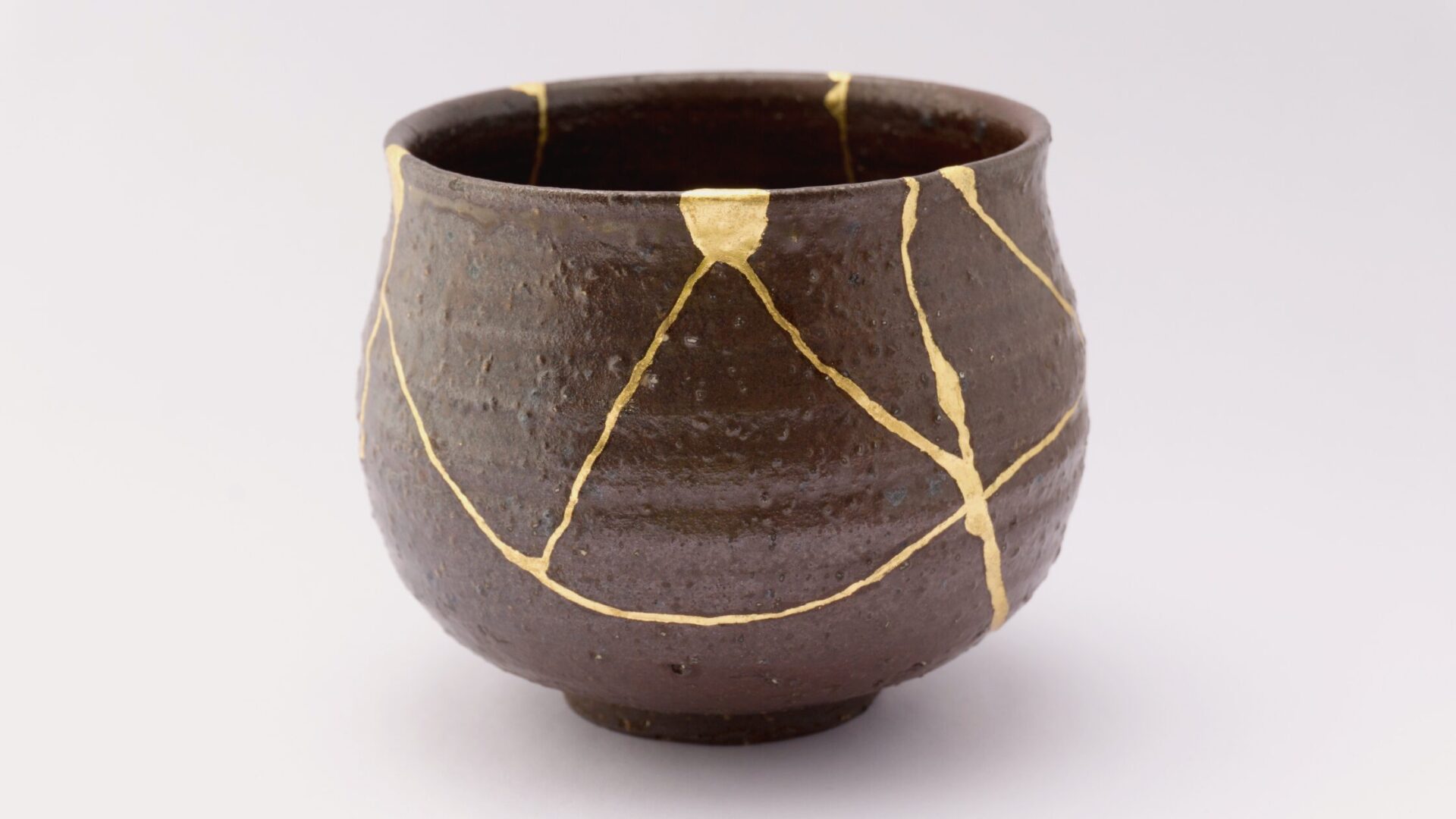
Kintsugi (金継ぎ, literally “golden joinery”) is a Japanese method of repairing broken ceramics using urushi lacquer mixed with gold, silver, or platinum powder. Rather than hiding the damage, kintsugi makes the repair visible — tracing fracture lines in gold and presenting the history of breakage as part of the object’s design.
The practice emerged from Japan’s tea ceremony culture during the Muromachi and Momoyama periods (roughly the 14th through 17th centuries). In that world, imperfect, asymmetrical tea bowls were prized over symmetrical Chinese imports. The marks left by use — called keshiki, or “landscape” — were considered worth preserving, not erasing. Kintsugi is widely understood to have developed within this broader tea culture that valued imperfection and use, though no single origin point is definitively documented.
The Materials and Process
Traditional kintsugi uses natural urushi lacquer as adhesive, with metallic powder applied over the repair. Lacquer cannot be force-dried; it cures slowly in warm, humid conditions — typically in a dedicated damp box called an urushi-muro — through a natural process that requires careful environmental control. Artisans work through multiple stages — adhering, filling gaps, sanding, finishing — over weeks or months. Some traditional workshops take up to six months to complete a single piece.
The Story of Sen no Rikyu and the Cracked Tea Jar
One story from the tea ceremony world captures the spirit of kintsugi more vividly than any definition (accounts differ on historical accuracy, as with many oral traditions in Japanese arts).
At a tea gathering attended by the great tea master Sen no Rikyu, a host presented a famous tea jar called Unzan no Katatsuki. Rikyu seemed unimpressed. In frustration, the host smashed the jar. A guest gathered the pieces and had them repaired. When Rikyu later saw the restored jar, he said: “Now this is a magnificent tea jar.”
The story doesn’t end there. When someone later suggested repairing the repair — smoothing out the misaligned joints — the aesthete and tea master Kobori Enshu disagreed: “It is precisely because the joints don’t align that Rikyu found it interesting. Leave it as it is.”
Repair, in this telling, is not a return to an original state. It is the emergence of something new — something that only becomes possible through the experience of breaking.
The Philosophy of Broken Things
Beyond Wabi-Sabi
Kintsugi is often discussed alongside wabi-sabi — the Japanese aesthetic that finds beauty in transience, impermanence, and the natural passage of time. The connection is real. Both reject the idea that objects must be flawless to be beautiful; both are rooted in Buddhist notions of impermanence (mujō).
But there’s a meaningful difference worth sitting with.
Wabi-sabi involves an active, intentional choice to find beauty in what is humble, impermanent, and incomplete — not merely passive observation of decline. Rikyu himself famously destroyed a garden of morning glories before a tea gathering, leaving only one flower, so that guests would have to imagine the rest. That act of negation was purposeful. What distinguishes kintsugi is the physical dimension of that choice: it involves stepping into the fact of breakage and doing something with it — introducing new materials, new time, new meaning where there was only loss. You might call it creative acceptance — neither denial nor passive surrender.
Repair Without Erasure
Much of Western restoration practice aims to return objects to an idealized original state — to make damage invisible, to rewind time. Kintsugi does the opposite. The gold lines announce the break. They say: this happened here, on this day, to this object.
What this means philosophically is that kintsugi doesn’t erase time — it accumulates it. The time before the break, the moment of breaking, and the time after repair all coexist on the same surface. The object becomes a kind of stratigraphy: layers of experience made visible and permanent.
One way to read this philosophically is through the lens of Nishida Kitaro’s concept of pure experience — the moment before subject and object separate. A bowl used daily for years absorbs something of the life lived around it. Kintsugi, read through that frame, preserves that relationship rather than severing it, carrying the scar forward rather than pretending it never existed.
The Role of Imagination
There’s another angle worth considering. To appreciate a kintsugi repair fully, the viewer has to participate — imagining what the piece looked like whole, or remembering it. The gap left by the break becomes a space that the imagination fills. This mirrors something deeper in Japanese aesthetics: the value placed on ma (negative space) and yohaku (the unpainted area of a painting). Meaning lives not only in what is present, but in what is pointedly absent.
The same quality has been noted in Western art: the Venus de Milo is widely considered more compelling for its missing arms than a complete sculpture would be. Whether that parallel is meaningful or merely coincidental is an open question. But it points to something that cuts across cultures — that incompleteness can be generative, inviting viewers in rather than shutting them out.
Kintsugi Goes Global — and What Gets Lost in Translation
The word kintsugi has traveled far from its origins in Japanese craft.
In the museum world, institutions like the Victoria and Albert Museum (V&A) in London have positioned it as a significant example of Japanese decorative arts. Museums in the UK and North America have also introduced it through exhibitions and public programming. These introductions were rooted in craft history and material culture.
By the 2010s, the concept had migrated into self-help and wellness discourse. In 2021, BBC Travel introduced kintsugi as “Japan’s ancient art of embracing imperfection,” framing it as a philosophy for building resilience. The Conversation described it as a model for “navigating failure.” At the University of Victoria in Canada, kintsugi was incorporated into an installation exploring anti-racism, memory, and healing.
The Gap Between Metaphor and Practice
This expansion is worth examining honestly.
In Japan, kintsugi remains grounded in craft practice and material technique, even when appreciated for its aesthetic and sometimes luxury dimensions. In much of the Western wellness conversation, “Kintsugi” has become a metaphor for self-acceptance that circulates largely independent of the technique itself. The academic literature in psychology doesn’t treat kintsugi as a clinical framework; it functions mainly as a compelling analogy in mindfulness and motivational contexts.
When a cultural practice travels across languages, something is always emphasized and something else fades. What risks disappearing from kintsugi-as-metaphor is the body of it: the months of waiting for lacquer to cure, the risk of urushiol allergy, the physical act of picking up pieces and fitting them back together. The metaphor lifts the meaning but leaves the material behind.
This isn’t an argument against the metaphor — just a reason to know the difference.
Kintsugi and Sustainability: Repair as a Way of Thinking
Kintsugi resonates with several currents in contemporary sustainability thinking, but it doesn’t map cleanly onto any of them. The friction is worth exploring.
The Right to Repair — and Where Kintsugi Parts Ways
The Repair Café movement, launched in Amsterdam in 2009, has spread to thousands of communities worldwide, offering spaces where volunteers help people fix broken electronics, clothes, and household objects. The Right to Repair movement — particularly active in the EU and US — challenges manufacturers’ restrictions on parts and information, arguing that designed-in obsolescence strips consumers of the ability to maintain what they own.
Both movements share kintsugi’s core impulse: resist the pressure to discard and replace.
But the endpoint differs. Right to Repair and Repair Cafés aim primarily to restore function — to return objects to their original specifications transparently. The ideal repair is invisible. Kintsugi does the opposite: it makes the repair the most visible thing about the object. The break is not erased; it is announced in gold.
Upcycling’s Limits
Upcycling — adding value to discarded materials by turning them into something new — has become a popular sustainability concept. But it typically involves disassembling the original object’s identity to create something else: a truck tarp becomes a tote bag, a wine bottle becomes a lamp. The original thing disappears.
Kintsugi preserves identity. The bowl remains a bowl. Its specific history of use, of being dropped, of being repaired, all remain intact. Unlike typical definitions of upcycling, nothing is disassembled or reinvented. One way to read this is through the lens of care ethics: not managing an object efficiently, but maintaining a relationship with it — acknowledging its vulnerability and continuing to show up for it. Carol Gilligan’s work described moral life as a web of relationships rather than a system of rules; Nel Noddings wrote about engrossment — receiving another’s reality as your own. When a kintsugi practitioner handles broken fragments, smoothing lacquer into a crack that someone else’s hands made, something of that quality is present: a response to the specific need of a specific object, rather than a generalized rule about what to do with broken things.
Donna Haraway’s concept of “staying with the trouble” can also be read as a frame here. Rather than solving the problem of breakage by discarding or transforming beyond recognition, kintsugi stays with the broken thing — inhabits the difficulty, works inside it, makes something from within it rather than around it.
Slow Time and Degrowth
Degrowth thinkers like Serge Latouche argue that economic growth cannot be infinitely sustained, and that human well-being requires slowing down, not accelerating. Read through that lens, kintsugi embeds slowness structurally. The lacquer cures on its own schedule. Weeks pass between layers. There is no way to rush it.
In my own experience learning kintsugi, the waiting changed how I thought about the cup. The longer the repair took, the more attached I became — not because the cup had become more valuable in any market sense, but because I had invested time in it. When it was finished, I didn’t feel like I had restored a possession. I felt like I had renewed a relationship.
Degrowth economics talks about shifting objects from commodities (interchangeable, replaceable) to companions (specific, irreplaceable). Kintsugi is one of the clearest practical illustrations of that shift I’ve encountered.
Related article: What Is Degrowth? A Beginner’s Guide to Rethinking Prosperity
Policy Context: Europe’s Push Toward Repair
France’s loi AGEC (Anti-Waste for a Circular Economy Law), enacted in 2020, introduced a mandatory Repairability Index (Indice de réparabilité) for electronics starting in 2021, scoring products from 0 to 10 based on how easily they can be repaired. The EU’s broader Ecodesign for Sustainable Products Regulation is pushing similar frameworks across member states.
These policies create infrastructure for repair. What they cannot create is the desire to repair — the felt sense that a broken object is worth the time. Kintsugi doesn’t scale as policy. But as a set of ideas that make repair feel meaningful rather than merely dutiful, it addresses something policy can’t reach.
How to Practice Kintsugi: Traditional vs. Modern Methods
If you’re considering trying kintsugi, here’s what’s useful to know before you start.
Traditional Kintsugi (Hon Kintsugi)
Traditional kintsugi uses natural urushi lacquer and metallic powder. The process involves multiple stages — bonding, gap-filling, sanding, finishing — repeated over weeks or months. Some courses run six months or longer.
The main safety concern is urushiol, the active component of urushi lacquer, which causes allergic contact dermatitis in many people — similar to poison ivy exposure. Many workshops and courses note explicitly that people prone to such reactions should avoid working with raw lacquer. The risk is in the uncured state; once fully hardened, urushi lacquer has been traditionally used for food-contact utensils — however, users should confirm suitability with the artisan or supplier, as specific use questions (microwave safety, heat tolerance) are not covered by a general safety claim.
Modern Kintsugi (Simplified Methods)
Modern kits use epoxy resin or synthetic lacquer instead of natural urushi, which allows repairs to be completed in a day or two. The tradeoff is food safety.
Under Japan’s Positive List system for food-contact materials (introduced June 2020, fully enforced after May 2025), synthetic resins used on food-contact surfaces must comply with listed substance requirements. If you intend to use repaired ceramics for food or drink, confirm that the kit explicitly states food-safe certification. Products without clear labeling should be treated as decorative only.
In the EU, food-contact materials are regulated under Regulation (EC) No 1935/2004 and related measures. The same principle applies: verify food-contact compliance before using a repaired piece for eating or drinking.
Finding Reliable Sources
- Major lacquerware production regions in Japan such as Wajima, Echizen, and Yamanaka, where certified artisans and workshops can be found
- Long-established lacquerware shops with clear material labeling and allergy warnings
- Japan’s Ministry of Health, Labour and Welfare (Positive List) and the EU’s food-contact materials regulations for compliance reference
For professional repair: pricing varies depending on the extent of damage and materials used, and completion typically takes several months.
Frequently Asked Questions
What does kintsugi mean? Kintsugi (金継ぎ) means “golden joinery” in Japanese. It refers to the practice of repairing broken ceramics with lacquer mixed with gold, silver, or platinum powder, making the repair visible rather than hiding it.
Is kintsugi a form of wabi-sabi? They’re related but distinct. Wabi-sabi is a broader aesthetic sensibility that values impermanence and natural imperfection — the beauty of things aging and fading. Kintsugi shares that appreciation for imperfection but involves active intervention: a person steps in and repairs the break, using the damage as the starting point for something new.
How long does traditional kintsugi take? Traditional kintsugi using natural urushi lacquer typically takes anywhere from several weeks to six months or more, depending on the number of breaks and the number of finishing layers required.
Is kintsugi safe for dishes you eat from? Natural urushi lacquer has traditionally been used for food-contact utensils once fully cured, but users should confirm suitability with the artisan or manufacturer. Synthetic kits vary — check for explicit food-safe certification and compliance with food-contact material regulations (Japan’s Positive List; EU Regulation EC 1935/2004).
Why is kintsugi associated with sustainability? Kintsugi keeps objects in use rather than discarding them. It connects to broader repair movements (Repair Cafés, Right to Repair), degrowth thinking, and care ethics — the idea that maintaining relationships with objects rather than cycling through them is both an ethical and ecological stance. It also challenges the aesthetic of perfection that makes discarding feel like the obvious choice.
Why is kintsugi popular outside Japan? Global interest grew in the 2010s through museum exhibitions and media coverage. The concept resonated particularly in wellness and resilience conversations — the idea that visible scars can become strengths. Some critics note that this metaphorical use simplifies the craft tradition. Both interpretations — philosophical and technical — are worth knowing.
Conclusion
When the cup was finished, I held it for a while.
The silver line followed the chip exactly. I didn’t feel like I’d fixed something. I felt like something had shifted in my relationship to it — from a replaceable object I happened to own to a specific thing with a specific history that I’d chosen to continue.
Rikyu’s enthusiasm for the repaired jar, Enshu’s instruction to leave the misaligned joints alone: both point to the same thing. Something opens up when you decide not to erase what happened. The break becomes part of the story instead of an interruption of it.
That’s not an argument for fixing everything that breaks, or for any particular lifestyle choice. It’s just a question worth sitting with: what would it mean to stop treating damage as the end of an object’s value, and start treating it as part of the record?
What’s something you’ve been keeping around, unrepaired?
Sources
- Government of Japan, Highlighting JAPAN, “The Art of Kintsugi” (August 2020)
- Victoria and Albert Museum, official collection notes on kintsugi
- BBC Travel, “Kintsugi: Japan’s ancient art of embracing imperfection” (2021)
- The Conversation, “How the philosophy behind kintsugi can help us navigate failure”
- Japan Ministry of Health, Labour and Welfare, Positive List System for food-contact materials
- European Commission, Regulation (EC) No 1935/2004 on materials intended to contact food
- Repair Café Foundation, official history (repaircafe.org)