

If you’ve stood in a Japanese drugstore aisle squinting at a bottle labeled 無添加 (mutenka, “additive-free”) or 地球にやさしい (“kind to the earth”) and wondered who’s actually checking that claim, you’re not alone. Japanese product labeling doesn’t always spell out certifications in English, and it’s easy to mistake a company’s own marketing language for independent verification.
This guide focuses on brands whose official sites display or clearly describe a third-party certification or certification mark — RSPO, B Corp, PETA’s cruelty-free statement, NCP, Leaping Bunny, and so on — rather than only a self-reported environmental claim. Brands that rely solely on their own life-cycle assessment (LCA) or in-house environmental standards were deliberately left out this time, even when their sustainability efforts are otherwise solid. Where something couldn’t be confirmed on the official site, we say so plainly instead of leaving it out silently.
Quick Summary: Best Pick by Priority
| If you care most about… | Go with | Why |
|---|---|---|
| Stacking up the most certifications in one product | ecostore | RSPO, B Corp, and PETA all confirmed on the official site |
| A Japan-made brand with RSPO certification | Yashinomi Concentrate | RSPO-certified; one bottle covers roughly 70 washes |
| A soap-based, additive-free formula | Arau. Laundry Soap | RSPO-certified; free of synthetic surfactants, brighteners, bleach, synthetic fragrance, coloring, and preservatives |
| Certification on a budget | Happy Elephant Compact | RSPO-certified option at a more accessible price point; free of petroleum-based surfactants, optical brighteners, bleach, synthetic fragrance, and coloring |
| A European ecological certification system | Sonett | NCP (product), CSE (company-wide), and Vegan Society certified; some raw materials from certified organic farming |
| Cruelty-free credentials specifically | Ecover Concentrate | Leaping Bunny-certified, plus B Corp status confirmed on the official site |
| Zero-rinse, zero-electricity washing | All Things in Nature | Uses RSPO-certified (mass balance) palm oil; supports rinse-free, power-free washing |
Our Selection Criteria
We evaluated each brand against seven criteria, based entirely on what’s published on the brand’s own official website. A brand not appearing here doesn’t necessarily mean it lacks a sustainability program — it means we couldn’t verify one from primary sources at the time of writing.
- Third-party certification — Is there independent verification (RSPO, B Corp, PETA, NCP, Leaping Bunny, etc.), rather than a self-reported claim?
- Restriction of harmful substances — Does the brand officially confirm the absence of petroleum-based surfactants, optical brighteners, synthetic fragrance, or artificial coloring?
- Biodegradability and water impact — Does the official site explain how the formula breaks down after it enters wastewater?
- Sustainable sourcing — Is there an official sourcing policy for renewable materials or palm oil?
- Recyclable packaging — Is recycled plastic, a refill pouch, or FSC-certified paper packaging confirmed officially?
- Concentration and resource efficiency — Does the brand explain how a concentrated or refill format reduces material or shipping impact?
- Cleaning performance — Is there an official claim of effective cleaning at low volumes or low water temperatures?
For this particular roundup, we filtered specifically on the first criterion: third-party certification. Products backed only by an in-house LCA standard or a self-developed environmental benchmark — including some well-known concentrated detergents from major Japanese manufacturers — were left out this time, regardless of how well they scored on the other six criteria. All information below reflects what was verifiable on each brand’s official site as of July 2026.
Related article: Why Eco-Friendly Laundry Detergents Matter: A Complete Guide to Choosing Safe, Sustainable Products
7 Sustainable Laundry Detergents in Japan
1. ecostore
🔍 RSPO-certified palm oil 🏢 B Corp certified (since 2021) 🐰 PETA cruelty-free commitment ♻️ Bottle blends sugarcane-based bioplastic with NZ-collected recycled plastic 📦 FSC-certified paper packaging 🚫 Free of petroleum-based surfactants, synthetic fragrance, and synthetic coloring
Of the seven brands in this roundup, ecostore — a New Zealand brand widely available through Amazon Japan and Rakuten — stacks up the widest range of third-party certifications.
Its palm-derived ingredients are certified through the Roundtable on Sustainable Palm Oil (RSPO). The brand’s own “Our Palm Policy” page addresses the deforestation and orangutan habitat loss linked to conventional palm oil sourcing, and explains why it sources RSPO-certified oil instead.
ecostore also holds B Corp certification, awarded in 2021 after an assessment of the company’s social and environmental governance as a whole — not just this one product. On animal testing, the brand has signed a formal statement to PETA committing that no ingredient, formulation, or finished product is tested on animals, by the company or on its behalf. This is a signed commitment rather than an accredited certification in the same sense as RSPO or B Corp, but it’s still a specific, checkable claim rather than vague marketing language. Between sourcing (RSPO), the company as a whole (B Corp), and animal testing (the PETA statement), that combination is what sets ecostore apart here.
The bottle is made from a blend of sugarcane-based bioplastic and plastic collected and recycled within New Zealand (the bulk 5kg, 5L, and 20L formats use standard HDPE instead). All paper packaging is FSC-certified. The laundry liquid itself is a concentrated formula, and the product page confirms it’s free of petroleum-based surfactants, synthetic fragrance, and synthetic coloring.
Editor’s take: RSPO covers sourcing, B Corp covers the company as a whole, and the PETA statement covers animal testing — three specific, checkable claims, three different angles. If “does this actually have third-party backing” is your main filter, this is the brand to check first.
Trade-off: ecostore is imported from New Zealand, so factor in shipping distance if that matters to you. We couldn’t find specific biodegradability data, or claims about rinse cycles or cold-water performance, on the product pages we reviewed.
View on ecostore Japan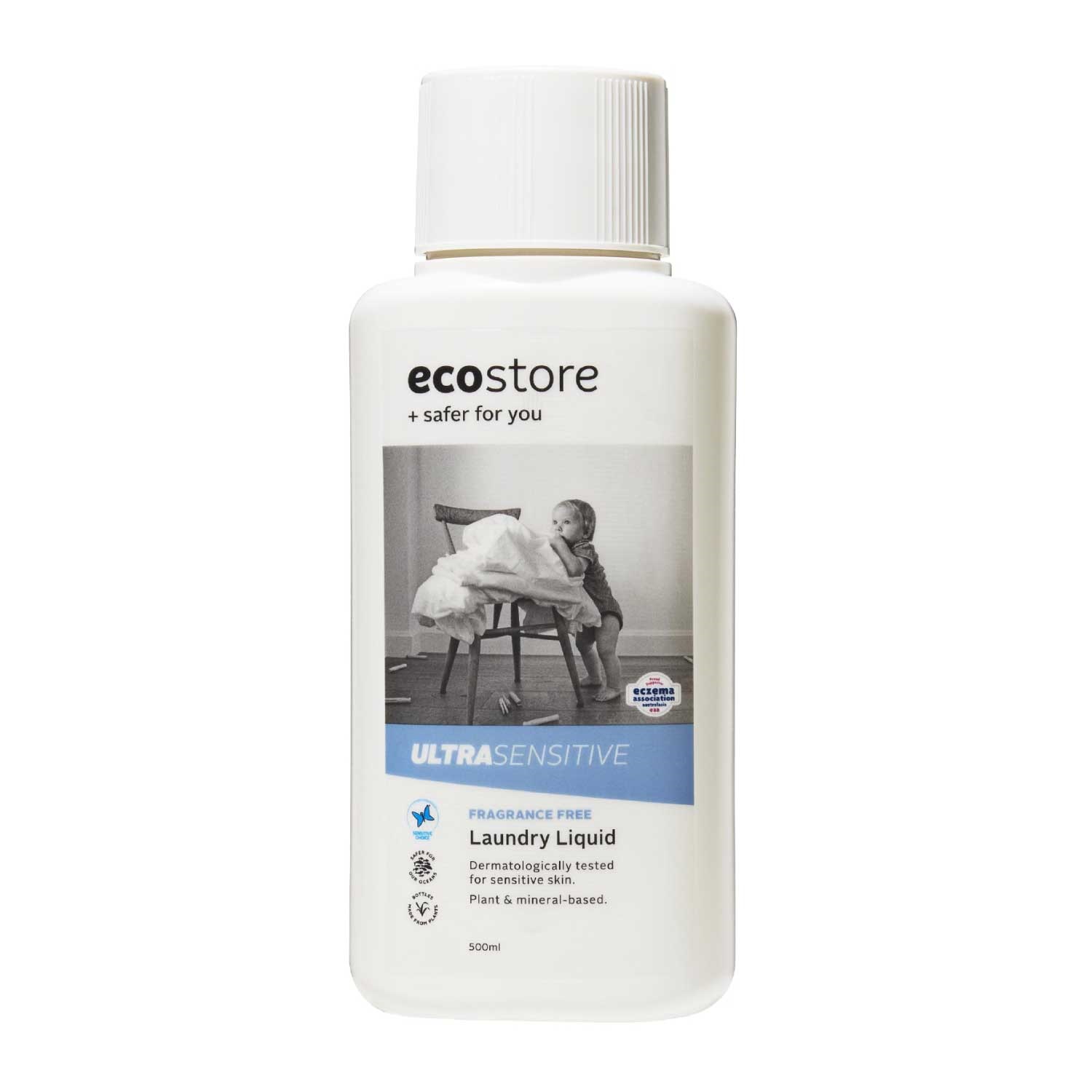

2. Yashinomi Laundry Detergent Concentrate (Saraya)
🔍 RSPO certification mark 🚫 Free of petroleum-based surfactants, brighteners, bleach, synthetic fragrance, coloring, and antibacterial agents 🌱 100% coconut-derived plant surfactants ♻️ Breaks down via microbial action after entering wastewater 💧 Concentrated formula, roughly 70 washes per bottle ⏱️ Rated for a single rinse cycle
Yashinomi (“coconut fruit”) traces back to 1971, when Saraya launched the original dish soap under this name — the concentrated laundry version reviewed here is a later addition to the same product family, not a product that itself dates to 1971. The official site displays the RSPO certification mark and confirms the brand supports the spread of palm oil produced with environmental and human rights safeguards.
It’s free of petroleum-based surfactants, optical brighteners, bleach, synthetic fragrance, coloring, and antibacterial agents. The official site states that residue breaks down via microbial action into water and carbon dioxide after entering wastewater. One 520mL bottle covers roughly 70 washes at concentrated dosing, and it’s rated for a single rinse cycle, which saves both time and water. One percent of sales goes toward conservation work in Borneo, according to the official site.
Editor’s take: What stands out is that the RSPO certification isn’t presented in isolation — it’s tied directly to where the palm oil comes from and what the brand funds there (Borneo conservation). It’s a rare case where you can trace the certification all the way to its real-world impact from the official site alone.
Trade-off: We found no official mention of certifications beyond RSPO (no B Corp or cruelty-free program listed). How much recycled or plant-based resin goes into the packaging varies by product line within the Yashinomi family, so check the specific bottle you’re buying.

 ポチップ
ポチップ
3. Arau. Laundry Soap (Saraya)
🔍 RSPO certified 🚫 Free of synthetic surfactants, brighteners, bleach, synthetic fragrance, coloring, and preservatives 🌱 100% plant-derived pure soap ♻️ Breaks down via microbial action after entering wastewater 📦 Refill pouches (1L, 2L, 950mL, etc.)
Arau. is Saraya’s soap-based laundry line. The official site confirms RSPO certification and states the brand supports the spread of sustainably sourced palm oil. It’s free of synthetic surfactants, optical brighteners, bleach, synthetic fragrance, coloring, and preservatives, and the site states that wastewater breaks down quickly via microbial action. A portion of sales goes through Save the Children to support hygiene and health programs for children in Uganda, according to the official site.
Editor’s take: If you specifically want a soap-based formula rather than a synthetic surfactant blend, the simplicity of the ingredient list here is reassuring. You’ll use more product per wash than with a concentrated liquid, but in exchange you get a shorter, more transparent ingredient list.
Trade-off: As a soap-based formula, it doesn’t make the “small amount per wash” claims that concentrated liquid detergents do. We didn’t find certifications beyond RSPO on the official site.
 ポチップ
ポチップ
4. Happy Elephant Liquid Laundry Detergent Compact (Saraya)
🔍 RSPO certification mark 🚫 Free of petroleum-based surfactants, optical brighteners, bleach, synthetic fragrance, and coloring 🌱 Natural surfactant "Sophorolipid" plus non-petroleum plant-based surfactants ♻️ Container partly made from plant-based resin 💧 Concentrated formula
A pH-neutral concentrated liquid marketed for everything from everyday clothes to delicates. The product page displays the RSPO mark and confirms the container is partly made from plant-based resin. It’s free of petroleum-based surfactants, optical brighteners, bleach, synthetic fragrance, and coloring, made instead with a natural surfactant called sophorolipid alongside non-petroleum plant-based surfactants; the site states the formula breaks down via microbial action in wastewater.
Editor’s take: Being able to use one bottle for both everyday laundry and delicates like wool or silk is a practical draw if you don’t want three different bottles in your laundry closet. Combined with the RSPO mark on the product page, it’s a certified option at a more accessible price point than some others on this list.
Trade-off: The official product page recommends two rinse cycles, unlike some concentrated detergents on this list that are rated for one. We didn’t find certifications beyond RSPO, or quantitative biodegradability data, on the official site.
 ポチップ
ポチップ
5. SONETT
🔍 NCP, CSE, and Vegan Society certified 🌱 Some raw materials (olive, rapeseed, sunflower, coconut, and palm oils) come from certified organic farming 🇩🇪 German brand
A German detergent brand whose official certifications page lists three distinct certifications: NCP (Nature Care Product), a product-level ecological standard for washing and cleaning products; CSE (Certified Sustainable Economics), which covers the company as a whole rather than a single product; and the Vegan Society label, confirming the formula contains no animal-derived ingredients. Worth noting: there’s no EU-regulated “organic” certification for detergents (that framework legally applies only to food), so Sonett’s own site frames NCP as an ecological product standard rather than an organic certification. That said, the brand does state that key raw materials used across its soap-based products — olive, rapeseed, and sunflower oil, along with coconut and palm fat — come from certified organic farming. The formula here is built around pure soap and alkyl glucosides, with fragrance from essential oils like lavender.
Editor’s take: NCP and CSE cover two different things — one the product, one the whole company — which is a more granular certification structure than most other brands on this list. Pairing this with the RSPO-certified options above gives you a genuinely different certification family to compare, not just another RSPO badge.
Trade-off: The official Japan retailer page (an import distributor, not Sonett’s own domain) recommends two or more rinse cycles, and we didn’t find specific claims about low-volume dosing or cold-water performance. Quantitative biodegradability data wasn’t available either.
 ポチップ
ポチップ
6. Ecover Laundry Liquid Concentrate
🔍 Leaping Bunny certified (Cruelty Free International) 🏢 B Corp certified (Europe's first) 🌱 Plant-derived surfactants (coconut oil, palm oil) ♻️ Bottle: 75% plant-based plastic + 25% recycled plastic
Founded in Belgium in 1979, Ecover’s official site states the company has never tested on animals since its founding, and holds Leaping Bunny certification — an international standard from a nonprofit dedicated to ending animal testing. A separate page on the same official site notes that Ecover was the first company in Europe to become a certified B Corporation, meaning it also holds B Corp status (an assessment of a company’s overall social and environmental standards). Its surfactants are derived from plant oils like coconut and palm.
Editor’s take: Like ecostore, Ecover pairs two certifications of a different nature — Leaping Bunny for animal testing, B Corp for the company as a whole — rather than relying on a single certification alone.
Trade-off: According to official information, the bottle is made of 75% plant-based plastic and 25% recycled plastic, not 100% recycled plastic. The brand has at times stated a goal of reaching 100% recycled plastic, but we couldn’t confirm that this has been achieved in the current product. The official site also recommends two rinse cycles, so it’s worth double-checking the exact product name and packaging (concentrate vs. the ZERO line) before you buy.
 ポチップ
ポチップ
7. All Things in Nature (Slow Village)
🔍 RSPO-certified (mass balance) palm oil ⏱️ Supports zero-rinse, zero-electricity washing 🌊 A portion of proceeds funds "Beach Money," a local ocean conservation initiative
Slow Village, a Japan-based online retailer built around the idea of “things that are good for your body, good for your mind,” sells this all-in-one detergent as an original collaboration. The official site confirms it uses RSPO-certified (mass balance) sustainable palm oil. The formula itself is based on an existing detergent from Gankohompo, a Japanese eco-detergent maker, repackaged as Slow Village’s own product. A 2023 winter reformulation added zero-electricity washing on top of its existing zero-rinse capability. A portion of proceeds supports “Beach Money,” a local currency tied to beach-glass conservation that’s run along the Shonan coast since 2006.
Editor’s take: What’s distinctive here is that, unlike some other private-label eco detergents, this one goes as far as naming its RSPO-certified palm oil sourcing on the official product page — not just a vague “eco-friendly” claim. The tie to a specific local ocean conservation program also makes it easier to see where your money actually goes.
Trade-off: We didn’t find certifications beyond RSPO (no B Corp or NCP mentioned) on the official site. There’s no quantitative biodegradability data either — the wastewater breakdown claim is described qualitatively rather than with test data.
View on the official website
Getting More Out of Concentrated and Refill Formats
Before you switch detergents, it might be worth adjusting how you’re using the one you already have.
If measuring feels like a hassle: Concentrated formulas use less per wash, so using the cap’s measurement line or a proper measuring spoon actually matters more than with regular detergent. Overdosing just means more residue in your clothes and more load on wastewater treatment.
If you’re not sure about rinse cycles: Some of these brands are rated for a single rinse, others recommend two. Since this varies by product, it’s worth checking the label before you set your washing machine — especially if your machine’s default cycle assumes Japanese detergent norms, which can differ from what you’re used to.
Once a bottle is empty: Most of these brands offer refill pouches or larger refill containers. Rinsing and air-drying the original bottle before refilling helps it last through several cycles instead of ending up in the recycling bin after one use.
FAQ
What does RSPO certification actually mean? RSPO stands for the Roundtable on Sustainable Palm Oil, an international nonprofit that certifies palm oil grown under standards meant to reduce deforestation and protect the rights of local communities and workers. A brand displaying an RSPO mark is sourcing at least some of its palm-derived ingredients through this certified supply chain, rather than making an unverified sustainability claim on its own.
Is a Japanese detergent labeled “無添加” (mutenka) automatically eco-certified? Not necessarily. Mutenka simply means “additive-free” and refers to specific ingredients the brand has chosen to leave out (like synthetic fragrance or coloring). It’s a useful data point, but it isn’t the same as third-party certification like RSPO or B Corp, which involves independent verification of a broader set of claims.
Can foreign residents in Japan easily buy these detergents? Most of the Japanese-brand options here (Yashinomi, Arau., Happy Elephant) are sold at major drugstores, supermarkets, and on Amazon Japan and Rakuten. ecostore, Sonett, and Ecover are more commonly found through import retailers or their own Japan-facing online stores, and may cost more due to import shipping.
Do any of these detergents ship internationally from Japan? This varies by brand and retailer, and wasn’t something we specifically verified for this article. If you’re planning to ship a product overseas, check the retailer’s shipping policy directly, since it may differ from the manufacturer’s own policy.
A Closing Thought
Looking into these seven brands, what stood out most is how few products in Japan can back up an eco claim with actual third-party verification, even a single certification. That’s not a knock on the major manufacturers we left out of this list — many of them are doing real work to reduce environmental impact through their own life-cycle assessments, and that effort is genuine. But knowing who’s checking the claim, and by what standard, seems like information worth having before you decide what matters to you.
Which certification would you actually check first: where the palm oil comes from, how the company operates as a whole, or whether animal testing was involved anywhere along the way?
Information in this article is based on each brand’s official website as of July 2026. Prices, formulations, and packaging are subject to change, so please confirm details on the official site before purchasing.