
Before we dive in: The most sustainable washing machine is often the one you already own. If your current machine is less than 10 years old, scroll to the maintenance section first. Still shopping? Read on.
Quick Answer: Best Sustainable Washing Machines in Japan by Goal
| Your Priority | Recommended Model | Why |
|---|---|---|
| Maximum longevity | Miele WCI 660 WPS | ~20-year durability testing standard; top EU energy rating |
| Best energy & water savings | Panasonic NA-LX129E | Eco Mark certified (verify number); heat pump drying; ~80L per wash cycle |
| Made in Japan | Hitachi BD-STX130M | BD-STX series traditionally manufactured in Ibaraki Prefecture; AI energy control |
| Water efficiency | Sharp ES-SW11K | Hole-free drum saves ~35L vs. comparable perforated drum models |
| Cost vs. ethics balance | Toshiba TW-127XP5 | RBA code of conduct adopted; ultra-fine bubble wash reduces detergent use |
Why This Guide Exists — And Why You Should Trust It
Most appliance comparison sites in Japan are built around two things: cleaning power and price. But if you’re reading this, you’re probably asking harder questions:
- Will this machine still be running in 15 years?
- Can I get it repaired, or will it end up in a landfill?
- Do the people who made it work in safe conditions?
This guide draws on primary sources including Japan’s Ministry of Economy, Trade and Industry (METI) energy efficiency standards, EU Ecodesign regulations, France’s repairability and durability indices, and RBA (Responsible Business Alliance) labor ethics reports. No manufacturer has paid for inclusion or placement.
The 6 Criteria We Use to Evaluate Every Model
Understanding these criteria will help you make your own informed choices — long after you’ve closed this tab.
1. Energy and Water Efficiency
In Japan, the Unified Energy Conservation Label (統一省エネラベル) is your most reliable benchmark. For drum-type washers, look at the achievement rate (%) against the 2027 fiscal year target — stars alone aren’t enough. For European models, the EU Energy Label (A–G scale) applies, with A as the highest class. When the revised label launched in 2021, virtually no machines achieved an A rating; by 2026, select high-end models from Miele and Panasonic’s European lineup are beginning to reach it.
Editor’s rule of thumb: ~80 liters or less per standard wash cycle = water-efficient.
2. Durability and Repairability
France’s Repairability Index (Indice de réparabilité) scores products out of 10 on parts availability and ease of disassembly. Since 2025, this is being superseded by the more comprehensive Durability Index (Indice de durabilité), which also evaluates robustness and maintainability.
Under EU Ecodesign rules, manufacturers must supply certain spare parts to professional repairers for up to 10 years. In Japan, the practical minimum is 6 years after a model is discontinued, though most major manufacturers hold parts for 8–10 years.
3. Environmental Materials and Manufacturing
Two certifications stand out: Eco Mark (エコマーク, Japan) — covering energy efficiency, hazardous substances, and recyclability — and Blue Angel (Blauer Engel, Germany) for European models. Always verify certification numbers are current.
On microplastic filtration: France mandated internal or compatible external filters on all new residential washers from January 1, 2025. Japanese-market models are not yet held to the same standard — verify individually if this is a priority.
4. Labor Ethics and Fair Manufacturing
RBA (Responsible Business Alliance) membership indicates a company has adopted the RBA Code of Conduct across labor rights, worker safety, and environmental standards. Membership ≠ every factory audited. Verify current status on the RBA official member list. Some brands (notably Miele) are not RBA members but maintain independently verified standards like UN Global Compact adherence and SA8000 compliance.
5. Where It’s Made
Japanese-manufactured models typically involve shorter domestic shipping distances — though the carbon footprint depends heavily on component sourcing. “Where was this made?” is a more meaningful question than it might seem.
6. Transparency vs. Greenwashing
What matters is whether environmental claims are backed by official labels, third-party certifications, and specific verifiable data. Watch for: recycled material content disclosure (e.g., “25%+ recycled resin in plastic housing”). Specific percentages signal authenticity; vague language signals caution.
Related article: Furniture Rental in Japan: A Honest Look at 6 Services and Their Sustainability Claims
The 13 Best Sustainable Washing Machines in Japan (2026)
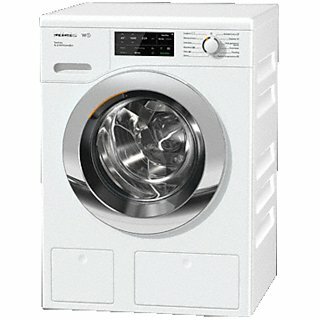
1. Miele WCI 660 WPS
~20-year durability testing · Top EU energy rating · Auto detergent dosing · SA8000-aligned labor standards
Miele’s benchmark claim — designing for approximately 20 years of use, based on 10,000-hour continuous operation testing — is the most credible statement of engineering intent in the industry. It is not a 20-year warranty; it is a design philosophy. The TwinDos automatic detergent dispensing prevents the chronic overconsumption that plagues most households. Miele is not an RBA member but adheres to UN Global Compact principles and independently verified labor standards comparable to SA8000.
Editor’s take: Calculate cost-per-year of ownership, not sticker price. The math changes considerably.
Trade-offs: 2–3× the upfront cost of Japanese-market competitors. Repairs require certified technicians; the domestic service network in Japan is still limited.

 ポチップ
ポチップ
2. AEG AWW8024D3WB
High EU energy label rating · Microplastic filter compatibility (verify with manufacturer) · Electrolux Group sustainability standards
One of the few brands actively engaging with Europe’s repair culture movement. Microplastic filter compatibility varies by configuration — verify compatible models directly with the manufacturer before purchasing.
 ポチップ
ポチップ
3. Panasonic NA-LX129E (2026 model)
Eco Mark certified (verify number) · Heat pump drying · ~80L water use per wash cycle · RBA Code of Conduct adopted
The most well-rounded Japanese-market option for buyers who want verified eco credentials alongside practical features. Heat pump drying significantly reduces electricity use versus heater-based drying. The ~80L per cycle water figure places this among the more water-efficient machines available in Japan.
Editor’s take: The realistic best choice for expats who want a washer-dryer combo without sacrificing efficiency.
Trade-offs: Parts retention ~8–10 years — respectable, but below Miele’s standard. The domestic repair network is far more accessible Japan-wide.
 ポチップ
ポチップ
4. Hitachi BD-STX130M (2026 model)
Traditionally Japan-manufactured (verify for your specific unit) · AI energy optimization · RBA Code of Conduct adopted
The BD-STX series has historically been produced at Hitachi’s Taga Plant in Ibaraki Prefecture. Some components are sourced internationally; lower-tier models may differ. Confirm production origin for the specific unit you’re considering. The AI optimization genuinely adapts to your usage patterns over time.
 ポチップ
ポチップ
5. Sharp ES-12X1 (2026 model)
Hybrid heat pump + heater drying · Micro high-pressure wash · RBA Code of Conduct adopted
Micro high-pressure washing pressurizes water to penetrate fabric fibers without high volumes. The hybrid drying system balances speed and energy use well.
 ポチップ
ポチップ
6. Panasonic NA-LX127E
High unified energy label rating · Eco-conscious design · RBA Code of Conduct adopted
Comparable energy and water performance to the LX129E at a lower price. The right choice for buyers who want strong credentials without the flagship feature set.
 ポチップ
ポチップ
7. Sharp ES-SW11K (top-load)
~35L water savings vs. comparable perforated drum models (Sharp official data) · RBA Code of Conduct adopted
Sharp’s hole-free drum design (穴なし槽) keeps water inside the wash tub rather than an outer reservoir, inhibiting mold and bacteria growth while saving ~35L per cycle. Practical for smaller apartments and single-person households.
 ポチップ
ポチップ
8. Toshiba TW-127XP5 (2026 model)
Ultra-fine bubble washing · Strong eco-mode energy performance · RBA Code of Conduct adopted (via Toshiba Lifestyle / Midea Group)
Ultra-fine (nano) bubbles penetrate fabric at a molecular level, allowing effective cleaning with less detergent. Toshiba’s home appliance division operates under Midea Group ownership — a company with substantial ESG reporting programs. Worth knowing before you buy.
 ポチップ
ポチップ
9. Hitachi BD-SX120M
Japan-manufactured (verify by unit) · Energy-efficient · Strong domestic repair network
A compact Hitachi option maintaining the domestic production tradition (verify for your specific unit). The Japan-wide service network is a meaningful advantage for long-term ownership.
 ポチップ
ポチップ
10. Panasonic NA-VG2900 (Cuble)
Energy-efficient design · Panasonic corporate supply chain transparency · Distinctive cube design
The square form factor is genuinely distinctive — a machine you might want visible rather than hidden. Supply chain transparency here refers to Panasonic’s corporate-level reporting, not a model-specific certification.
 ポチップ
ポチップ
11. Sharp ES-X12C
Low noise operation · Eco sensor auto-optimization · RBA Code of Conduct adopted
For apartment dwellers running laundry at night: low-noise design and eco-sensor load detection that automatically selects the optimal cycle.
 ポチップ
ポチップ
12. Toshiba TW-127XP4
Low power consumption in eco mode · RoHS compliance policy published (Toshiba Lifestyle Group) · RBA Code of Conduct adopted
Hazardous substance management (RoHS) is addressed at the group level. Verify the specific certification number for this model on the manufacturer’s official page.
 ポチップ
ポチップ
13. Hitachi BD-SG110K
Japan-manufactured (verify by unit) · Straightforward durable design · RBA Code of Conduct adopted
No headline features — and that’s partly the point. Fewer complex systems mean fewer failure points. There’s a quiet reliability in restraint.
 ポチップ
ポチップ
Brand-by-Brand Trade-Off Summary
| Brand | Strengths | Weaknesses |
|---|---|---|
| Miele | Industry-leading durability testing; repairability philosophy; independent labor ethics verification | High upfront cost; limited domestic repair network in Japan |
| Panasonic | Eco Mark certification; water efficiency; extensive Japan repair network | Parts retention ~8–10 years (confirm per model) |
| Hitachi | High-end models traditionally Japan-made; AI efficiency; fast domestic repair | Manufacturing origin varies by model — always verify |
| Sharp | Best-in-class water efficiency via hole-free drum; strong eco-mode performance | Fewer drum-type washer options |
| Toshiba | Ultra-fine bubble technology; Midea Group global ESG management | Home appliance division is Midea Group-owned — understand the supply chain |
| AEG | European design standards; microplastic filter engagement | Japan repair infrastructure still limited; filter compatibility needs official confirmation |
The Option Nobody Talks About: Not Buying a New One
Is your current washing machine still working?
Manufacturing a new washing machine requires significant energy and raw materials. If your current machine is less than 10 years old, maintaining and repairing it may be the most sustainable decision available to you.
Maintenance steps you can do right now:
- Clean the lint filter monthly — a clogged filter increases energy consumption
- Run a drum cleaning cycle every 3 months — prevents mold and maintains wash performance
- Use the correct detergent amount — overuse means extra rinse cycles and wasted water
- Call your manufacturer’s support line — repairs are often cheaper than expected, particularly with Japanese brands
Ask yourself honestly: Is the machine actually broken — or do I just want something new? A repair bill of ¥20,000–¥30,000 is almost certainly less resource-intensive than manufacturing and shipping a replacement.
Frequently Asked Questions
Q: Are Miele washing machines worth the price in Japan? If longevity and repairability are your priorities, yes. Calculate cost-per-year of ownership — including energy, water, and repair costs — rather than sticker price.
Q: What does Japan’s Eco Mark certification mean for washing machines? It’s a third-party certification by the Japan Environment Association verifying energy efficiency, hazardous substance limits, and recyclability. Always confirm the current certification number on the official Eco Mark database.
Q: Do washing machines sold in Japan have microplastic filters? Not as a standard or legal requirement as of 2026. France mandated them from January 1, 2025. If this is a priority, verify external filter compatibility for your model, or research European-specification models.
Q: What is Japan’s minimum spare parts retention period? The practical minimum is 6 years after a model is discontinued. Most major manufacturers hold parts for 8–10 years. EU regulations require professional repair access to certain parts for up to 10 years.
Q: What does RBA membership actually mean? A company has adopted the RBA Code of Conduct covering labor rights, worker safety, environmental management, and ethics across its supply chain. It does not guarantee every factory has been independently audited.
A Note on Information Currency
This article reflects research conducted in early 2026. Certifications, specifications, prices, production locations, and product availability are subject to change. Always verify current details on each manufacturer’s official website before purchasing.
This article was researched and written independently. No manufacturer sponsorship or advertising placements influenced selection or rankings.
Sources: METI Unified Energy Conservation Label guidelines; Japan Environment Association (Eco Mark); EU Ecodesign Regulation (EU) 2019/2023; France’s AGEC Law (Indice de réparabilité / Indice de durabilité); Responsible Business Alliance Code of Conduct; individual manufacturer sustainability reports and official product specifications.