
This article starts with one request: pause before you buy. If you’ve already decided to replace your futon, let’s at least make sure it’s worth it.
Quick Summary: Best Pick by Priority
| Your Priority | Best Pick | Why |
|---|---|---|
| Maximum certification transparency | SaFo | GOTS-certified since 2009 — Japan’s first. Certificate PDF publicly available. |
| Animal welfare matters to you (down futon) | Omotesando Futon-ten | RDS certificate published on official site. Recycled down as primary material. |
| Minimize chemical exposure | Neugu no Iwata | OEKO-TEX covers every component — fabric, thread, and zipper included. |
| Make your current futon last longer | Neugu no Iwata / Watafuton | Refilling and restoration (uchinaoshi) treated as core business philosophy. |
| Participate in down recycling | Nishikawa | Founding board member of the Green Down Project. Nationwide collection. |
| Easy in-store option (major chain) | MUJI (Mujirushi Ryohin) | ReMUJI down collection program runs year-round at every store in Japan. |
| Not sure you need to buy yet | → | Skip to the bottom of this article |
A Note from the Editors: Why You Can Trust This Article
Every brand in this article was verified by visiting each official website directly. We did not rely on review aggregators, shopping comparison sites, or Amazon listings. If a brand claims to be “eco-friendly” or “organic” but doesn’t publish certification numbers, certifying body names, or specific material specs on their official site, we treated that claim as unverified — and left it out.
During research, we found several cases where secondary sources described certifications that we couldn’t confirm on the brand’s own site. Those details were cut. We also excluded brands that don’t sell futons directly, brands without independent official websites, and catch-all category entries that aren’t reviewable as single products.
One more thing worth noting: many of these brands have Japanese-only websites. We’ve done the reading so you don’t have to — and where the Japanese is important, we’ve explained it. But for final purchase decisions, we strongly recommend confirming current stock and services with each brand directly.
Editor’s Note: All certification details, product specs, and production location information reflect what was published at the time of writing (2025). Certification standards — including GOTS, OEKO-TEX, and RDS — are subject to revision. Always verify with each brand’s official site before purchasing.
What Is a Futon? (A Quick Note for the Newcomer)
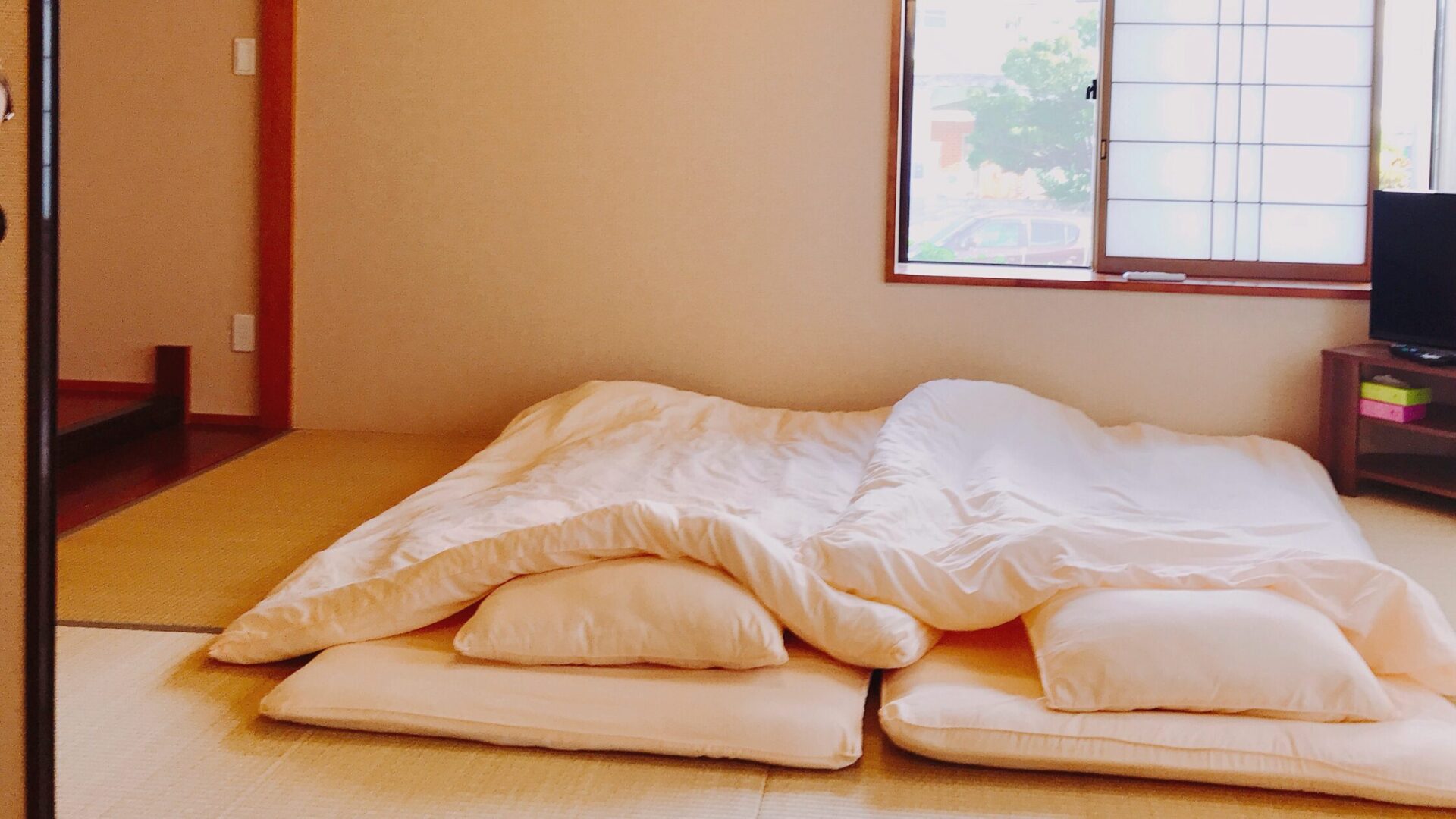
In Japan, a futon (布団) is not the fold-out sofa bed you may know from the West. It’s a set of floor-level bedding: a thick padded sleeping mat (shikibuton, 敷き布団) that goes on the floor, and a quilted comforter (kakebuton, 掛け布団) that goes on top of you.
Traditional futons are filled with cotton batting, down, wool, or silk. They’re designed to be aired out on sunny days, folded away into a closet (oshiire, 押し入れ) during the day, and used for years — sometimes decades. That culture of care and longevity is itself a form of sustainability that predates the modern concept by centuries.
Related item: How to Choose a Sustainable Mattress: 7 Brands Evaluated by Materials, Certifications, and End-of-Life Options
The 6 Criteria We Used to Select These Brands
1. Materials and Manufacturing: What’s Actually Inside
“Natural = eco” is not a reliable shortcut. Organic cotton, for example, still has a significant environmental footprint from irrigation water and — in conventional growing — pesticides. Polyester is petroleum-derived, essentially non-biodegradable, and a known source of microplastic shedding. When evaluating materials, you need to look at pesticide use, water consumption, biodegradability, and product lifespan together.
Two certifications are worth knowing before you start shopping:
GOTS (Global Organic Textile Standard) covers the entire supply chain — from organic farm to finished product — and requires compliance with both environmental standards (no chlorine bleaching, restricted heavy-metal dyes, wastewater treatment) and social standards (ILO core labor conventions, including bans on child labor and forced labor).
OEKO-TEX STANDARD 100 is a different kind of certification. It tests finished textiles for harmful substances — PFAS, prohibited azo dyes, heavy metals, pesticide residues — and certifies that the product is safe for human contact. It is not an organic certification. The two serve different purposes, and a brand that holds both is covering more ground.
Our standard for this article: Either certification must be accompanied by the certifying body’s name and/or license number. A logo alone — without traceable credentials — gets a lower score.
2. Animal Welfare and Labor Ethics
Down comforters touch one of the more complicated ethical corners of the bedding world. The supply chain involves meat-industry byproducts, multiple intermediary handlers, and processing facilities — a structure that historically made it easy for live-plucking (removing feathers from live birds) and force-feeding to go undetected.
RDS (Responsible Down Standard), managed by Textile Exchange, directly addresses this. It prohibits live-plucking and force-feeding, requires pre-slaughter stunning as of its 2019 revision, and extends audits to parent-bird farms — where the risk of live-plucking is highest due to the birds’ longer lifespan. Chain of custody traceability from farm to finished product is also required.
On the cotton side, ILO reports have consistently flagged low wages, child labor, and unsafe pesticide handling in major growing regions. GOTS addresses this directly: its social compliance requirements apply to every facility in the certified supply chain, not just the farm.
Our standard: Third-party certification from RDS, RWS, or GOTS. We do evaluate brands with self-reported traceability, but we clearly distinguish it from third-party-verified claims.
3. Durability, Waste Reduction, and Circular Design
According to Japan’s Ministry of the Environment (FY2023 data), the recycling rate for clothing and textiles in Japan is approximately 15%. Most of the rest is incinerated or sent to landfill. Futons — which are classified as oversized waste (sodai gomi, 粗大ごみ) — are a significant contributor to this problem.
Two distinctly Japanese approaches to reducing futon waste are worth knowing:
Uchinaoshi (打ち直し) is the traditional practice of restoring cotton futons. An artisan takes the flattened batting out, re-fluffs and cleans it, and sews it into new fabric cover. The result is essentially a new futon made from an existing one. This practice has existed in Japan for centuries, and several small workshops still offer it nationwide — including by mail.
The Green Down Project (一般社団法人グリーンダウンプロジェクト) is a nonprofit recycling system launched in 2015. Participating companies collect used down products, clean and reprocess the feathers to a standard described as “equal to or better than new,” and manufacture new products from the recycled material. The cycle covers collection, transport, disassembly, washing, manufacturing, sale, use, and re-collection.
Our standard: At least one of the following must be publicly listed on the official site — a repair/refill service, participation in a recycling scheme, or a take-back program.
4. Transparency and Greenwashing: How to Spot the Difference
Greenwashing in the bedding industry usually shows up in two ways. The first: big claims with no evidence — “eco-friendly,” “sustainable,” “natural” — and nothing certifiable behind them. The second: partial truths, like highlighting an “organic cotton cover” while the fill material is standard polyester, creating the impression that the whole product is environmentally responsible.
Japan’s Consumer Affairs Agency has been tightening enforcement around environmental marketing since 2024. Its guidelines on the Act Against Unjustifiable Premiums and Misleading Representations explicitly state that “emphasizing a partial fact to create a misleading impression about the whole product” constitutes an unfair representation. That second type of greenwashing — the partial-truth kind — is not a gray area under Japanese law.
What to look for: certification logos backed by the certifying body’s name and license number; published numbers for recycling volumes, CO2 reductions, or collection rates; and what the brand doesn’t say. A brand that publicly discusses its limitations is usually more trustworthy than one that doesn’t mention them at all.
Our standard: Certification logo plus certifying body name or license number, both present. Sustainability claims without verifiable data are not evaluated.
5. Design for Longevity: Does the Brand Actually Want You to Keep It?
The most sustainable futon is the one you already own. This criterion asks whether a brand actively designs for and communicates long-term use — through repair services, refill options, washable components, or a brand philosophy that explicitly discourages unnecessary replacement.
In Japan, this aligns naturally with the broader concept of mottainai (もったいない) — the cultural value of not wasting things that still have use left in them. Several of the brands in this article treat repair and restoration not as an add-on service, but as a core expression of what they’re for.
Our standard: At least one publicly explained service or design feature on the official site that actively supports keeping the product longer.
6. Supporting Small and Local Businesses
Futon-making has historically been a decentralized, regional craft in Japan, with manufacturers, cotton processors (seimensho, 製綿所), and skilled artisans distributed across the country. Brands that publicly disclose their factory location, craftspeople, and local partnerships aren’t just being transparent — they’re maintaining the economic and cultural infrastructure that makes artisan bedding possible.
Being large doesn’t disqualify a brand. But this criterion specifically recognizes brands that make their community ties visible and verifiable.
Our standard: Factory location, craftsperson involvement, or regional partnerships explicitly stated on the official site.
The 6 Picks: Full Reviews
1. Omotesando Futon-ten(表参道布団店。)
🔍 RDS certificate published on official site ♻️ Recycled down (Clean Cycle Down) as primary product 📍 Domestic production 🛁 Down futon reform service available
A growing number of brands in Japan claim RDS certification. Far fewer actually publish the certificate where customers can see it. Omotesando Futon-ten does. The RDS documentation — verifying compliance with bans on live-plucking and force-feeding, traceability through the parent-bird farm, and mandatory pre-slaughter stunning — is accessible on their site. That shifts the conversation from “we say we’re ethical” to “here’s the third-party proof.”
Their primary product line is called Clean Cycle Down — futons filled with recycled down rather than virgin feathers. When they do use new down, it’s exclusively RDS-certified. They’ve also structured the brand around non-ownership options: a monthly rental for their comforters, a reform service (Clean Cycle Reform) that refills and restores used futons instead of replacing them, and an overall refusal to cut corners for cost. The brand’s public communications — including a detailed production blog on their official note page — make their sourcing and manufacturing choices unusually transparent for a small Japanese business.
Editor’s take: If you’ve been hesitant about buying a down futon because you couldn’t verify the ethics behind it, looking at their RDS certificate is a good place to start. The answer shifts from “probably fine” to “confirmed.”
Tradeoffs: Price is in the mid-to-high range compared to mass-market down futons. GOTS or OEKO-TEX certifications covering the shell fabric were not confirmed on their official site at the time of writing — so if chemical exposure in textiles is a concern for you, follow up with them directly.


 ポチップ
ポチップ
Website (Japanese): Omotesando Futon-ten
2. SaFo (サフォ)
🌱 GOTS-certified (ECOCERT) — Japan's first, since 2009 📍 Otoyocho, Kochi Prefecture — in-house factory 🔍 Certificate PDF publicly available ✅ Shell and fill both 100% organic cotton
SaFo is operated by a Kochi-based company called Heart Co., Ltd. (株式会社ハート). In 2009, they became the first bedding manufacturer in Japan to receive GOTS certification from ECOCERT, the French organic certifying body. The claim is verifiable: the certification body name, year of acquisition, and a downloadable PDF of the certificate are all on their official site. GOTS certification covers the full supply chain — from organic farm through spinning, dyeing, sewing, and final product — with both environmental requirements (no chlorine bleaching, restricted dyes, wastewater management) and labor standards (ILO core conventions, including child labor and forced labor prohibition).
SaFo sells futon comforters (kakebuton), lightweight summer comforters, and sleeping mats (shikibuton) — a full lineup of the main futon types. Both the shell fabric and the fill are 100% GOTS-certified organic cotton. No fluorescent brighteners, no dyes, no bleaching agents. Dust-mite resistance is achieved through high-density weaving rather than chemical treatment. Their factory in Otoyocho is documented on the site with photographs of actual production — cotton batting, layering, sewing — which is genuinely uncommon transparency for a Japanese bedding manufacturer.
Editor’s take: If you’ve spent time searching “organic cotton futon Japan” and come away more confused than when you started, SaFo is where to look first. The certificate, the factory, the materials — all of it connects in one place.
Tradeoffs: SaFo doesn’t carry down or wool products. Cotton fill is heavier than down. There’s currently no publicly described take-back or futon restoration program for customers.
 ポチップ
ポチップ
 ポチップ
ポチップ
Website (Japanese): SaFo Official / SaFo Online Store
3. Neugu no Iwata — 寝具のイワタ (IWATA)
🧪 OEKO-TEX STANDARD 100 — full product coverage including thread and zipper 📍 Kyoto headquarters, in-house factory 🛁 Restoration service accepts other brands' products too ✅ Unbleached line: zero dye, zero bleach
Most OEKO-TEX certifications in bedding cover the outer fabric or fill material. Iwata’s certification extends to the thread and zipper — every component of the finished product. If you’re someone who thinks carefully about what touches your skin at night, that detail matters. The brand also offers an “unbleached” (アンブリーチド) product line: cotton fill and fabric that has never been dyed or bleached, processed using Japanese domestic fabric with no resins or adhesives.
Their refurbishment service, branded as the UMO® Upgrade Service, accepts products from other manufacturers — not just their own. The service is framed not as a practical add-on but as a statement of principle: on their site, they describe restoration as “a way of protecting nature.” The product page tagline — “loving one piece of bedding for a long time” — reflects a brand orientation that isn’t trying to sell you something new.
For expats in Japan who want to actually understand what they’re buying and potentially restore it years later, Iwata is one of the more accessible entry points. Their online store has English-language support, and their product descriptions are more detailed than most.
Editor’s take: “Taking care of good things so they last” and “sustainability” can sometimes feel like they’re in different conversations. With this brand, they’re the same conversation.
Tradeoffs: RDS certification for their down products was not confirmed on their official site at time of writing. If down animal welfare is your primary concern, contact them directly before purchasing. Pricing is in the mid-to-high range.
 ポチップ
ポチップ
Website (Japanese/English available): Iwata Online Store / Iwata Corporate Site
4. Nishikawa (西川)
♻️ Founding board member — Green Down Project 🔍 J-TAS label: origin and import route traceable per product 📍 Made in Japan (Yamagata, Omi, and other domestic facilities) 🛁 Nationwide futon reform service
Nishikawa has been making bedding since 1566 — it’s Japan’s oldest and largest bedding company. The reason it’s in this article isn’t history; it’s infrastructure. As a founding board member of the Green Down Project, Nishikawa leads nationwide collection and recycling of used down products. Used futons are collected, cleaned, and reprocessed into recycled down that goes into new products. The circular system — collection, transport, disassembly, washing, manufacturing, resale, re-collection — is documented on their sustainability page in detail.
On traceability: Nishikawa attaches a J-TAS label (a Japanese industry traceability standard operated by the Japan Bedding Industry Association) to all down products, allowing customers to verify the feather’s country of origin and import route after purchase. It’s one of the only major bedding companies in Japan where that kind of product-level provenance check is available to consumers.
Editor’s take: Futon recycling fails in practice when people don’t know where to bring things. With Nishikawa, the answer is simple — find your nearest department store or bedding shop. That accessibility is a form of sustainability that matters.
Tradeoffs: RDS certification (the international standard for down animal welfare) was not confirmed on their official site during our research. J-TAS covers origin and import route — it is not an animal welfare certification. For large companies, it’s worth noting that some may meet equivalent animal welfare standards through internal procurement codes (Supplier Code of Conduct) without holding a third-party label. Since we couldn’t verify this on their public site, it’s not reflected in our evaluation. Follow up with them directly if this is a priority. As a major corporation, this brand doesn’t fit the small-business and regional support criterion (⑥).
 ポチップ
ポチップ
Website (Japanese): Nishikawa Official
5. MUJI (Mujirushi Ryohin — 無印良品)
♻️ ReMUJI down futon take-back and recycling program — all stores, year-round 🔍 Annual sustainability report with quantified collection data ✅ Circular design for down bedding
MUJI is in this article because of one thing: the ReMUJI program. Collected down futons are cleaned, dried, and refined, with material reincorporated into new products. The program runs at every MUJI location in Japan, year-round, without special procedures. That removes one of the biggest friction points in sustainable consumption — the “I don’t know where to bring this” problem. Their annual sustainability report quantifies collection volumes and environmental outcomes, satisfying the information transparency criterion.
For foreigners in Japan, MUJI is also one of the easiest brands to navigate. Store staff are accustomed to non-Japanese customers, English product tags are increasingly common, and their website has an English interface. If you want to buy a futon on your first week in Japan and return it responsibly when you leave, MUJI is the most frictionless path.
Editor’s take: The most sustainable action is the one you actually take. MUJI makes it easy enough to actually take it.
Tradeoffs: RDS certification (down animal welfare) and GOTS (organic textiles) were not confirmed on their official site at time of writing. A secondary source cited in our research claimed RDS certification, but we were unable to verify this from primary sources, so it’s not included in our evaluation. For large companies, internal procurement standards may cover equivalent territory without a third-party label — but again, we can’t confirm this publicly. Verify directly before purchasing. MUJI does not qualify under the small-business and regional support criterion (⑥).
 ポチップ
ポチップ
Website (Japanese/English available): MUJI Official (Japan)
6. Ishitaya (石田屋) — Supplementary Entry
📍 Kanazawa, Ishikawa Prefecture 🔍 Self-disclosed: origin, washing process, and wastewater treatment ✅ Rare natural materials sourced directly
Ishitaya is included as a supplementary entry because — despite holding no third-party certifications — the quality and specificity of their self-disclosure is unusual. Their down is sourced directly from Weidegans in Austria. Their site states that only feathers with documented traceability from birth through harvesting are used. Washing uses organic detergent rather than chemical agents, and post-wash water is purified before being returned to the lake. That level of process transparency, explained in the brand’s own voice on their official site, is rare in the Japanese bedding market.
The important caveat: everything described above is self-reported. It has not been externally audited by GOTS, OEKO-TEX, RDS, or any equivalent certifying body. Self-disclosure and third-party certification are not the same thing in terms of verifiability. We present this brand as an example of transparent communication — not certified sustainability.
Editor’s take: Being willing to explain your process publicly — not just claim outcomes — is its own kind of honesty. Certification and transparency aren’t the same thing, and Ishitaya demonstrates the latter without the former.
Tradeoffs: No third-party certification means the accuracy of disclosed information cannot be independently verified. There is no publicly described take-back, recycling, or uchinaoshi restoration program at time of writing. Shoppers seeking GOTS, OEKO-TEX, or RDS certification will need to look elsewhere.
Website (Japanese): Ishitaya Official
Brand Comparison at a Glance
| Brand | Key Strengths | Key Limitations |
|---|---|---|
| Omotesando Futon-ten | RDS certificate public, recycled down primary, reform service | No GOTS/OEKO-TEX confirmed. Mid-to-high price. |
| SaFo | GOTS Japan-first (certificate public), 100% organic cotton, factory documented | No down or wool products. No take-back program. |
| Neugu no Iwata | OEKO-TEX full-product coverage, unbleached line, restoration philosophy | RDS not confirmed publicly. Mid-to-high price. |
| Nishikawa | Green Down Project leader, J-TAS, nationwide collection infrastructure | RDS not publicly confirmed. Large corporation. |
| MUJI | ReMUJI collection at all stores year-round, quantified reporting | RDS/GOTS not publicly confirmed. Large corporation. |
| Ishitaya | Self-disclosed origin, wash process, wastewater — small specialist | No third-party certification. No repair/take-back described. |
Before You Buy: How to Make Your Current Futon Last
The most sustainable futon is the one you’re already sleeping on. Here’s what you can do before replacing it.
- Air it out regularly. Hang your futon outside on a sunny day for two to three hours. This removes moisture and creates an inhospitable environment for dust mites. Most Japanese futon owners do this year-round, weather permitting — it’s one reason Japanese futons last as long as they do. Check the care label for your specific fill material before hanging in direct sunlight.
- Wash the cover more than you think necessary. The cover is the first line of defense for the futon itself. Washing it every two to four weeks dramatically extends the life of the fill and shell fabric underneath.
- If your cotton futon has gone flat, consider uchinaoshi before disposal. Uchinaoshi (打ち直し) — the traditional Japanese practice of re-fluffing and re-casing cotton batting — is still offered by specialty workshops across Japan, including by mail order. Watafuton (watafuton.com) is one example that accepts orders nationally. The result is a futon that functions like new, made almost entirely from what you already own.
- Recycle your down futon instead of binning it. Before putting an old down futon out as sodai gomi (oversized waste), check whether your nearest MUJI store has ReMUJI collection running, or whether a Nishikawa-affiliated shop offers a take-back service. Either option diverts the feathers from landfill.
- “Old” isn’t the same as “done.” Unless the futon has structural damage that affects sleep quality, hygiene problems that can’t be resolved, or fill that can’t be restored — it probably doesn’t need to be replaced. The feeling that something is simply “due for an upgrade” is worth examining.
A question worth sitting with: Is your futon actually unusable — or does it just feel familiar? That distinction is where sustainable consumption starts.
Sustainable consumption isn’t about buying better things. It’s about staying thoughtful about what you already have.
Frequently Asked Questions
What is the difference between GOTS and OEKO-TEX certification? GOTS (Global Organic Textile Standard) certifies that a product uses organic fibers and that every step of production — from farm to finished goods — meets environmental and labor standards. OEKO-TEX STANDARD 100 is a harmful-substance test: it certifies that the finished product doesn’t contain hazardous chemicals at harmful levels. GOTS is about how something is made; OEKO-TEX is about whether the result is safe to use. They address different questions and can both apply to the same product.
What does RDS certification mean for a down futon? RDS (Responsible Down Standard) is a third-party certification managed by Textile Exchange. It prohibits the live-plucking of feathers from live birds, prohibits force-feeding, requires pre-slaughter stunning, and audits the full supply chain from farm to finished product — including parent-bird farms. A futon that carries RDS certification has had its down supply chain independently verified against these standards.
What is uchinaoshi, and is it worth doing? Uchinaoshi (打ち直し) is the Japanese practice of restoring cotton futon batting. A specialist opens the futon, removes the batting, cleans and re-fluffs the cotton fibers, and sews them into a new fabric casing. The process typically takes one to two weeks and costs less than buying a new futon. It’s particularly effective when the cotton has flattened but hasn’t degraded — which is the most common reason cotton futons lose their comfort. For travelers or expats in Japan, it’s worth knowing this option exists before disposing of an older cotton futon.
Can I recycle my futon in Japan? It depends on the type. Down futons can potentially be recycled through MUJI’s ReMUJI program or Nishikawa-affiliated retailers, both of which participate in the Green Down Project’s recycling system. Cotton futons can be restored through uchinaoshi workshops. Futons with synthetic fill (polyester) are harder to recycle and are most commonly disposed of as sodai gomi (oversized waste), though some municipalities are beginning to offer textile recycling for them. Check your local ward office’s waste guidelines for specifics.
Are there English-language options for buying sustainable futons in Japan? Nishikawa and MUJI both have English-language web interfaces. Neugu no Iwata’s online store (iwata-online.com) has some English support. SaFo and Omotesando Futon-ten’s sites are primarily Japanese, but both have accessible online stores where product descriptions can be translated using browser tools. For in-store shopping, MUJI and Nishikawa department store counters are generally the most accessible for non-Japanese speakers.
A Final Note on Information Currency
The research for this article was conducted in 2025. Certification standards — GOTS, OEKO-TEX, RDS, and others — are updated periodically, and brand offerings, certification status, and service availability change over time.
Before making a purchase, confirm current details on each brand’s official site. When checking certifications, look past the logo: the certifying body name and license number are what allow you to verify a claim independently. Getting into the habit of asking for both is one of the most practical tools against greenwashing.
If you find anything in this article that has changed or is inaccurate, we’d like to know. Please reach out to the editorial team.
This article was researched and written independently by the Eco-Philosophy editorial team using our own evaluation criteria.